June 7, 2026
17 No-Prep Airport Games for Kids During Long Layovers
Stuck at the airport with restless kids and no supplies? Discover screen-free layover activities that keep 3 to 7 year olds entertained using just your surroundings.
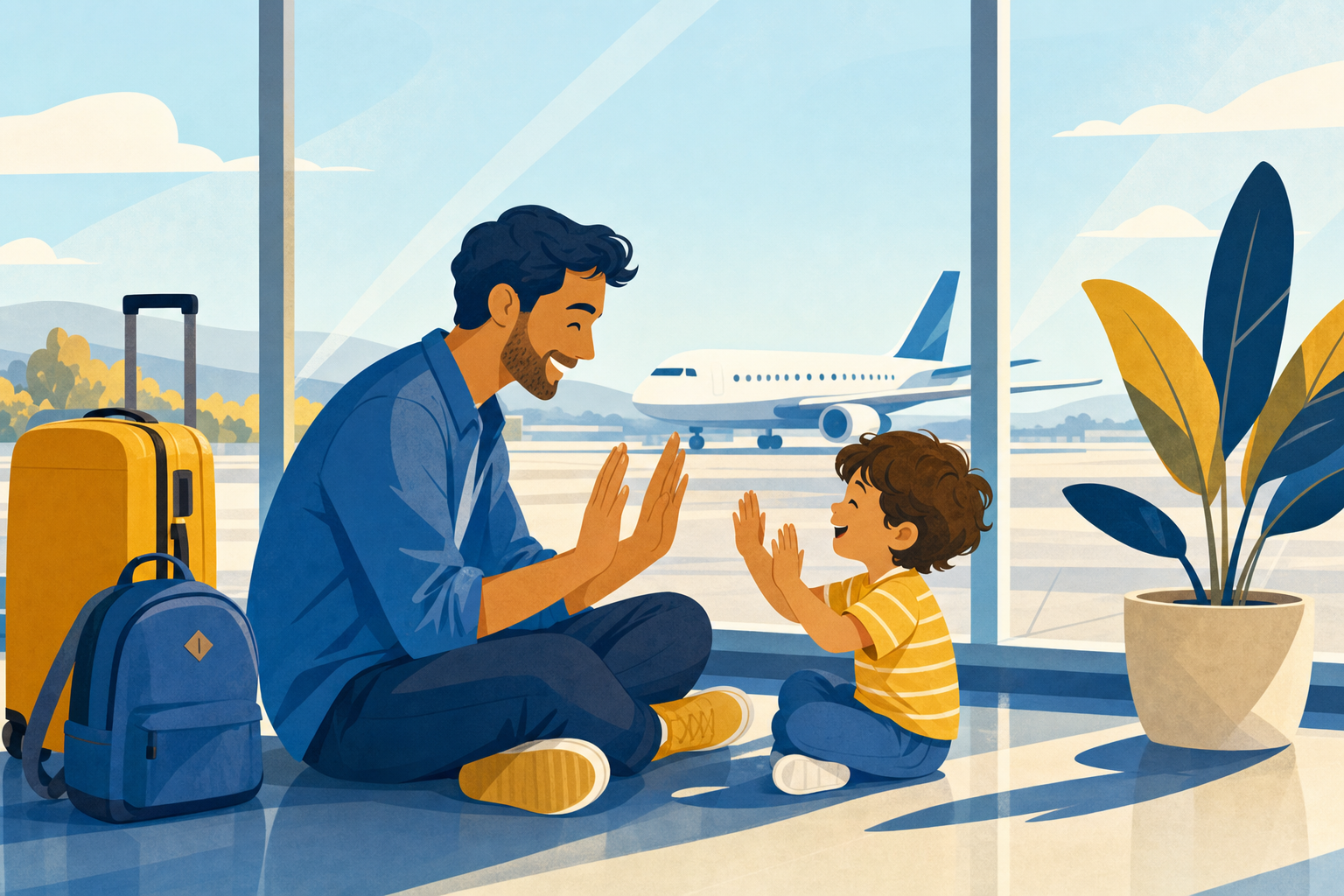
How to Keep a 3- to 7-Year-Old Entertained on a Layover with No Screens, No Coloring, and Almost No Carry-On Supplies
Your connecting flight just got delayed two hours, your kid's backpack is checked, and the tablet died somewhere over Kansas. Now you're standing in a terminal with a restless preschooler, zero supplies, and the sneaking suspicion that this layover might actually break you.
Here's the truth: long layover activities for kids don't require a perfectly packed bag or a Pinterest-worthy activity kit. Most of what you need is already in the terminal. You just need to know where to look and how to frame it so your kid stays engaged without losing their mind (or yours).
Walk the Terminal Like You're on a Mission
Airports are giant mazes, and kids love mazes. Turn the whole terminal into a scavenger hunt by giving your child specific things to find: a red suitcase, someone wearing a pilot uniform, a plane with a yellow tail, a water fountain, or a window where you can see the baggage carts.
Call out each item as you spot it. Let them lead the way to the next gate, the next bathroom, the farthest food court. The goal isn't to get anywhere in particular. The goal is to burn energy and keep their brain busy with something other than "how much longer."
If you have a pen and a napkin from the last snack stop, write down a quick list of five things to find. Cross them off together. Kids this age love checking boxes, even imaginary ones.
Turn Waiting Areas into Obstacle Courses
Most gate seating areas have open floor space between the chairs and the windows. Use it. Set up a path your child has to follow: step only on the dark tiles, walk heel-to-toe along the edge of the carpet, balance on the metal footrests of the chairs without touching the seats.
Make it a timed challenge. "Can you walk from this chair to that trash can in ten steps?" Count out loud together. Then do it again in eight steps, then twelve.
This works especially well for 3-year-olds and 4-year-olds who need to move but don't have the attention span for a long walk. It's contained, low-mess, and doesn't require you to chase them across three concourses. It also doubles as a no-prep travel activity for kids that looks like play but actually tires them out before boarding.
Play Memory and Guessing Games Using What's Around You
Airport games for toddlers and preschoolers don't need cards or props. Use the gate announcements, the departures board, the people walking past.
Start with "I Spy" but make it specific: "I spy someone with a blue backpack." Let them guess. Then switch roles. Keep it moving.
For older kids in the 5-to-7 range, try "What's Missing?" Point out four things they can see (a chair, a trash can, a yellow sign, a woman with a red coat). Have them close their eyes. You change one thing by moving slightly or pointing to a different object. They open their eyes and guess what's different.
Another option: "Who's Going Where?" Pick a random traveler and make up a story together about where they're going and why. Your kid picks the person, you start the story, they add the next part. Keep it going as long as they're interested. It's screen-free airport entertainment that works anywhere there are people.
Use Food Courts and Snack Stops as Built-In Breaks
Buying a snack isn't just fuel. It's an activity. Let your child pick the food court or snack stand. Let them carry the money (or watch you tap the card). Let them choose where to sit.
Once you're sitting, stretch the snack into a game. Count the Goldfish crackers before eating them. Sort the pretzels by shape. Guess how many sips it takes to finish the juice box. Build a tower out of napkins.
If you're near a window with a view of the tarmac, narrate what's happening with the planes. "That truck is bringing the suitcases. See the conveyor belt? Let's count how many bags go up." It's not revolutionary, but it works when you need ten minutes of calm.
This is also a good time to mention that printable activities like simple coloring sheets from Chunky Crayon can save a layover if you plan ahead, but when you don't have them, food becomes the pivot point between meltdown and making it through.
Claim a Quiet Corner and Do Movement Games
If your gate area is empty or you find a hallway with low foot traffic, use the space for follow-the-leader, freeze dance (you hum the music), or Simon Says. Keep the instructions simple and the movements small. Touch your toes, spin in a circle, hop on one foot three times.
For 3-year-olds, even "Can you stand like a tree?" or "Show me how a penguin walks" is enough. They don't need a structured game. They need permission to move and a reason to do it.
If you're worried about bothering other travelers, pick a corner near the windows or by the family bathroom where fewer people are camped out. Most parents see another parent managing a layover and give you space.
This works well in combination with what to do with kids during a layover when you've already walked the terminal twice and the snacks are gone. You're not entertaining them with stuff. You're letting them be physical in a place that demands sitting still.
Teach Them Something Small and Let Them Practice
Layovers are long enough to actually teach a 5-year-old how to tie their shoe, how to snap their fingers, or how to count backward from twenty. Pick one thing. Show them once. Let them try. Cheer when they get close.
It doesn't matter if they master it. What matters is they're focused on something other than boredom. You're also giving them a win they can brag about later ("I learned to whistle at the airport!").
For younger kids, practice the alphabet, counting by twos, or naming animals that start with each letter. Keep it playful. If they lose interest after three minutes, you're done. Move to the next thing.
Rotate Between Activities Every 15 to 20 Minutes
The mistake most parents make during airport waiting is trying to find one activity that lasts the whole layover. It doesn't exist. Not for this age range.
Instead, plan to rotate. Walk for fifteen minutes. Sit and play a guessing game for ten. Snack for fifteen. Do an obstacle course for five. Walk again. The variety is what keeps them (and you) from losing it.
If you've already survived waiting room visits without screens or restaurant waits with preschoolers, you already know this rhythm. Layovers are just longer versions of the same survival strategy: keep moving between activities before the current one turns into a fight.
When You're Truly Out of Ideas, Narrate Everything
If you hit the wall and your kid is done with games, walking, snacks, and obstacle courses, just start talking. Narrate what you see. "That plane is so big. I wonder how many people fit inside. Let's count the windows. One, two, three..."
Ask questions you already know the answer to. "Do you think that truck is bringing food or suitcases? What do you think is inside?" Let them guess. Agree with whatever they say.
Describe the process of what's happening around you. "See that family? They're boarding now. They're walking down that hallway to get on the plane. When it's our turn, we'll do the same thing."
It's not particularly engaging for you, but it keeps them anchored. For 3-year-olds and 4-year-olds especially, hearing your voice and having something to look at is sometimes enough to hold off a meltdown for another twenty minutes.
Layovers Are Survivable Without the Perfect Packing List
You don't need a bag full of carry-on activities for long flights to make it through a long layover. You need low expectations, a willingness to walk the same terminal loop three times, and the ability to turn a napkin into a game.
Most of the screen-free airport entertainment that works isn't about preparation. It's about noticing what's already there (the planes, the people, the tiles on the floor, the chairs) and reframing it as something your kid can interact with.
The layover will end. The flight will board. And your 5-year-old will probably fall asleep ten minutes after takeoff, which means all of this was just to get you both to that moment without anyone crying in public.
That's a win.