October 22, 2026
Flight Delay Activities for Kids: 2-Hour Airport Plan
Stuck at the gate? Try this screen-free flight delay activity rotation for ages 2 to 10, plus what to pack for a long airport wait with kids.
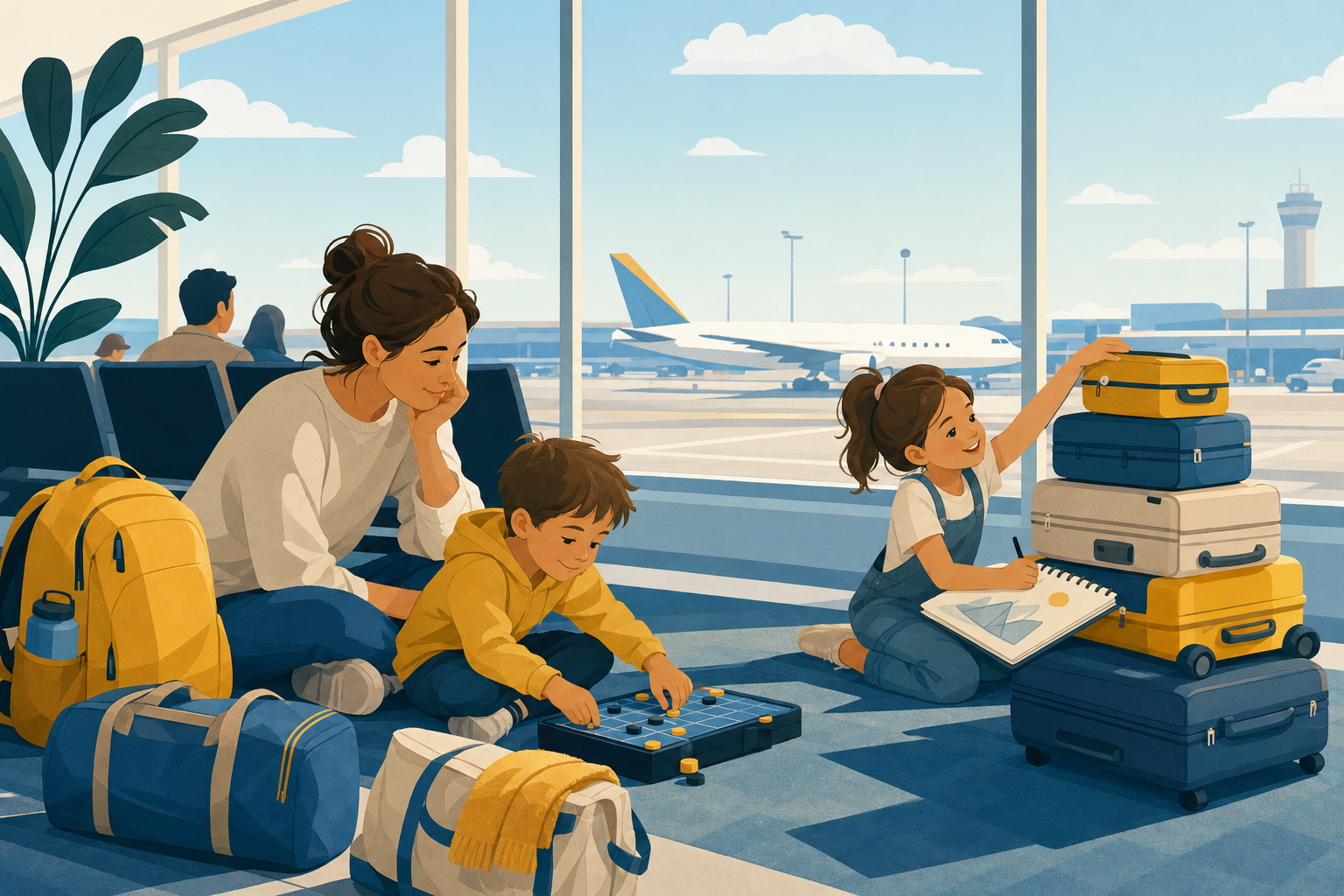
What to Do With Kids During a Long Flight Delay Without Screens: A 2-Hour Airport Waiting Plan for Ages 2 to 10
The gate agent just said "at least two more hours" and your kid is already lying face down on the floor by the charging station. You packed snacks. You packed one toy. Neither is going to cover two hours. Here's a plan that actually breaks the wait into chunks you can survive, without handing over a tablet.
Why One Big Activity Bag Doesn't Work at Hour Two
Most advice about flight delay activities for kids tells you to pack snacks, a coloring book, and a small toy, then hope for the best. That works for the first 20 minutes. By minute 40, the toy is boring, the snacks are gone, and you're negotiating with a 4-year-old about why they can't run laps around the gate.
The problem isn't the supplies. It's that kids need variety and structure during an unpredictable wait, not one activity stretched thin. A long airport wait with children goes better when you think in rotations, not in one long stretch of "keep them busy."
The 2-Hour Rotation: Break It Into Blocks
Instead of one activity bag, think of the delay as six blocks of roughly 15 to 20 minutes each. Switching activities before boredom sets in keeps everyone calmer than waiting for a meltdown and then scrambling.
Here's a simple kids travel activity rotation you can repeat or reorder depending on your gate situation:
- Movement block (15 min): Walk the terminal, find the moving walkway, count airplanes out the window.
- Quiet table activity (15 min): Travel-size puzzle, sticker book, or a small drawing pad.
- Snack and talk block (10 min): Slow down over a snack while playing a verbal game (see below).
- Imagination block (20 min): Pretend play with small figures, a sock puppet, or "airport I spy."
- Second movement block (15 min): Another walk, this time with a mission like "find three people wearing red."
- Wind-down block (15 to 20 min): Quiet seated activity to prep for boarding, like a coloring page or a simple matching game.
If the delay stretches past two hours, just loop back to block one. The repetition itself is calming for younger kids.
Age-Banded Plan: What Actually Works at Each Stage
A 3-year-old and an 8-year-old need very different tools, even in the same rotation.
Ages 2 to 4
- Short bursts, 10 minutes max per activity.
- A small busy bag with textured items (pipe cleaners, a zippered pouch, a tiny notebook) works better than toys with lots of pieces you'll lose on the floor.
- Simple imitation games: "Can you hop like this?" or "Show me your scared face."
- Walking missions are gold at this age: find something red, find a dog, find a person with a hat.
Ages 5 to 7
- This age can handle 15 to 20 minute blocks and simple rules.
- Travel-size games like tic-tac-toe on paper, a mini matching card set, or a small magnetic drawing board hold attention well.
- Verbal games work great here too: 20 Questions, "I'm going on a trip and I'm packing...", or naming animals by letter.
- If you've used a visual routine at home, a mini version of a visual transition schedule can help this age group move between activity blocks without protest, since they already recognize the "next" cue from home.
Ages 8 to 10
- Kids this age can self-direct for longer stretches, 20 to 30 minutes, especially with a challenge attached.
- Give them a notebook and a scavenger hunt list: count how many different airlines you see, find a clock, spot someone reading a paper book.
- Card games (War, Go Fish, Spoons if you have a group) travel well and need zero setup.
- Let them help manage the family's rotation schedule. Being