October 20, 2026
Screen-Free Flight Delay Activities for Kids Ages 2-10
Stuck at the gate? Try these screen-free airport waiting games and a printable scavenger hunt to keep kids ages 2 to 10 happy during delays.
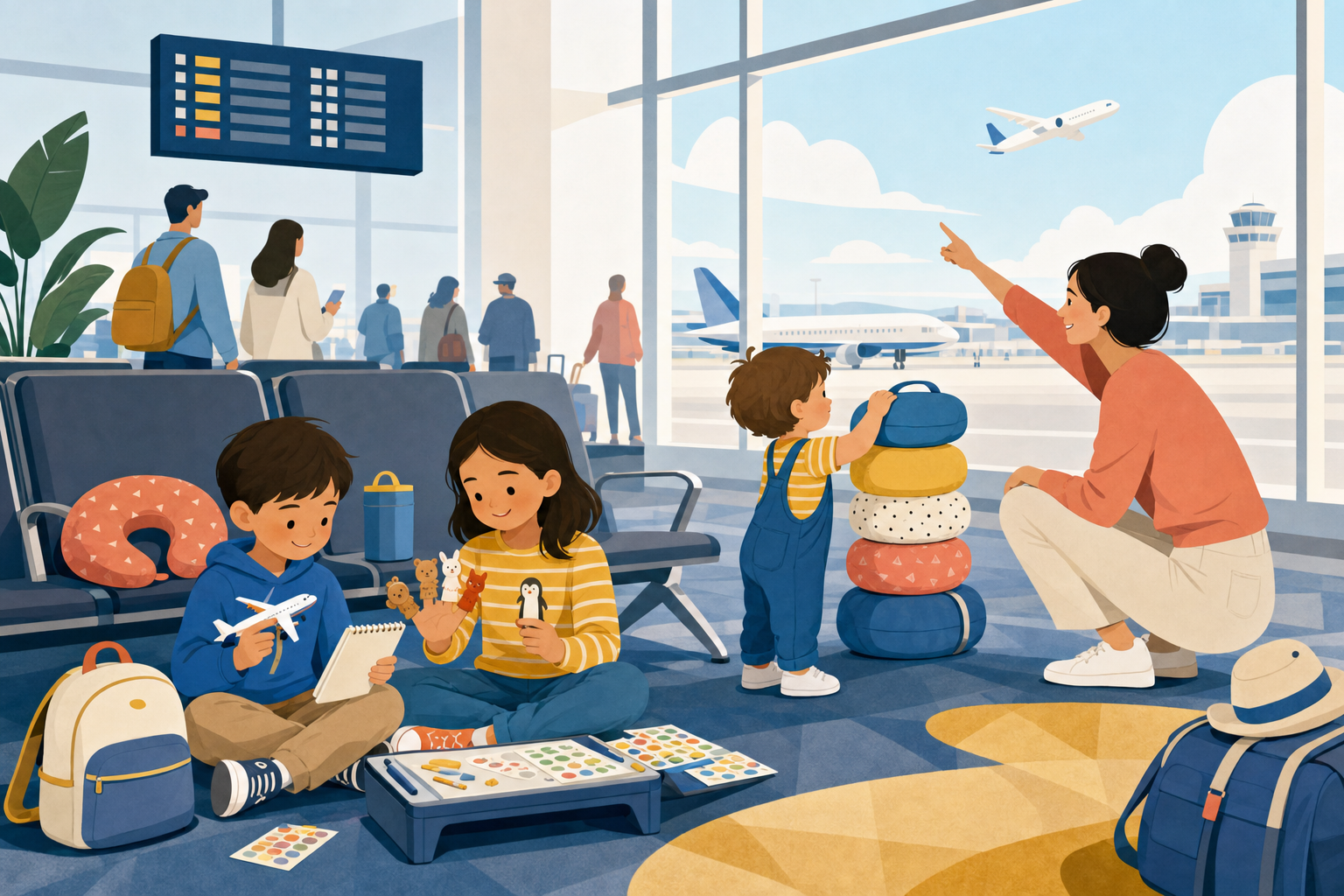
What to Do With Kids During a Long Flight Delay Without Screens: A Gate-Change-Friendly Plan for Ages 2 to 10
The gate agent just said "delayed, new boarding time pending" and your kids heard it before you finished processing it. Now you've got a toddler trying to climb the seats, a 7-year-old asking for your phone every four minutes, and no idea if you'll be sitting at gate B12 for one hour or four. This is a different kind of waiting than a traffic jam or a doctor's office. You can't spread out your supplies, you might have to pack up and walk to a new gate with zero warning, and everything you brought already got picked over during the TSA line.
Here's a plan that works with those constraints instead of ignoring them.
Why Airport Delays Need Their Own Plan
Most advice for keeping kids busy assumes you're staying in one spot with your full bag open on the floor. Airports don't work that way. You need activities that:
- Fit in a lap or a small pouch, not spread across a table
- Can be paused and resumed instantly when the gate changes
- Don't need extra supplies you already used up in security
- Work in a loud, crowded space without knocking into strangers
That rules out anything with lots of small pieces, liquid, or a setup time longer than 30 seconds. Everything below passes that test.
The First 5 Minutes After You Hear "Delayed"
Before you start any activity, do a quick reset. It takes less time than arguing about it later.
- Confirm the new gate or status, even if it's "unknown." Kids calm down faster once a grown-up names the plan out loud: "We're waiting here for at least an hour, then we'll check again."
- Do one lap together. A short walk burns off the jolt of disappointment, especially for kids under 6.
- Claim a landing spot near a pillar or wall so you're not in the main walking path when you pull things out.
This isn't an activity, it's damage control. Skipping it usually means every activity after it fails.
The Age-Banded Plan
Ages 2 to 4
Toddlers need movement and repetition, not complexity.
- Suitcase stacking or sorting: let them sort items from your bag by color or size, then put them back. Repeat.
- Airplane spotting: point out the planes outside the window and ask them to find one that's the same color as their shirt.
- Quiet noisemaker toy: a small squish ball or a few die-cast cars kept just for this moment work better than anything with buttons.
If you're short on new ideas for this age group, the same screen-free approach used for independent indoor activities for kids ages 2 to 10 translates well to a gate area; the trick is picking the quietest, most contained versions.
Ages 5 to 7
This age group can follow simple rules and loves a mission.
- I Spy with a twist: instead of colors, use categories like "something with wheels" or "someone wearing a hat."
- Story chain: take turns adding one sentence to a made-up story about the destination you're flying to.
- Printable airport scavenger hunt: a simple list like "find a dog," "find a red suitcase," "find someone reading a book" keeps kids scanning the terminal instead of asking for your phone every few minutes.
This age band is almost identical to kids stuck in a stalled car, so a lot of the no-supply games from a 60-minute traffic jam game plan work just as well sitting on an airport bench.
Ages 8 to 10
Older kids get bored fastest because they're aware of how long the wait actually is. Give them something with a bit of challenge.
- Flight tracker guessing game: have them estimate the delay time based on the departure board, then check back every 20 minutes to see who guessed closest.
- 20 Questions using people or objects they can see nearby.
- A notebook challenge: write down three good things and one annoying thing about the day so far, no judgment allowed.
If this age group traveled recently by boat or ferry, the same low-supply screen-free tricks apply. The ideas in screen-free ferry activities for kids ages 2 to 10 were built for exactly this kind of open-ended, can't-predict-the-end-time waiting.
Build a Gate-Change-Friendly Activity Pouch
Before you even get to the airport, pack one small pouch (not the whole carry-on) with items you can grab in two seconds if you have to move gates fast:
- A printed scavenger hunt list, one per kid, folded small
- A few index cards for drawing or tic-tac-toe
- One small toy per child that doesn't need batteries
- A pack of stickers for the youngest kid
Keeping this separate from your main bag means a sudden gate change doesn't mean repacking everything. You grab the pouch, you grab the kid, you walk.
For the quiet moments once you're actually seated, printable coloring pages from Chunky Crayon are a mess-light option that doesn't need a table, just a lap and a flat surface like a tray or a book.
When Everyone's Done With Everything
After 90 minutes or so, even the best activities lose steam. When that happens:
- Switch to snack-as-activity: let kids build a trail mix from a few ingredients you brought, one handful at a time.
- Do a "guess the destination" game with another family's luggage tags (within reason, keep it light and not intrusive).
- Let the oldest kid be "gate reporter" and check the departure board every 15 minutes, giving them a job instead of a complaint.
A long delay is hard on everyone, not just the kids. Having a short, reusable rotation of activities means you're not inventing something new every 20 minutes, you're just cycling back through what already worked.
The goal isn't to make the delay fun. It's to get through it without a meltdown at gate B12 and without handing over the phone five minutes in. A little planning before you even leave the house makes that a lot more realistic.