October 25, 2026
Screen-Free Road Trip Activities for Non-Reading Toddlers
Keep preschoolers busy for hours with a screen-free car activity rotation needing zero reading skills and almost no parent help. Try it on your next trip.
How to Keep a Non-Reading Toddler Busy on a Long Road Trip: A Screen-Free Activity Rotation That Needs Almost No Parent Help
You cannot hand a worksheet to a 3-year-old and expect anything but a crumpled ball of paper in the footwell five minutes later. Most road trip activity lists assume a kid can read instructions, follow multi-step directions, or at least sit still long enough for you to explain the rules. If your child is 2 to 6 and cannot read yet, you need something completely different: activities that work without a word of explanation, because you are driving and cannot turn around every ninety seconds to referee.
This is the gap nobody fills. Here is a system built specifically for non-readers that keeps going with almost zero parent input.
Why Most Car Activity Lists Fail Non-Readers
Standard car game lists assume reading, counting past 10, or understanding abstract rules like "spot something that starts with B." A toddler who cannot read cannot do a license plate game, a road trip bingo card with text, or a workbook page with written prompts.
The other problem is parent bandwidth. If you are the only adult and you are driving, you cannot read instructions aloud every time the activity resets. You need things a toddler can start, understand, and repeat on their own, over and over, without a verbal explanation each time.
That means the activities need to be:
- Visual, not text-based
- Repeatable without new instructions
- Self-correcting (the toddler can tell if they did it "right" without you checking)
- Low-mess, because you are not pulling over to vacuum crumbs out of the car seat crevices
The Screen-Free Rotation System (No Instructions Needed)
Instead of one big activity, build a rotation of five small ones. Toddlers lose interest fast, but they will cycle back to something they already understand. Keep each item in its own labeled bag or pouch so your child can grab the next one without asking you what to do.
1. Picture-matching pouch. Cut simple images (animals, shapes, colors) from an old magazine or print small picture cards. Put two sets in a zip pouch. Matching needs zero reading and most toddlers understand the concept by 2.5 to 3 years old.
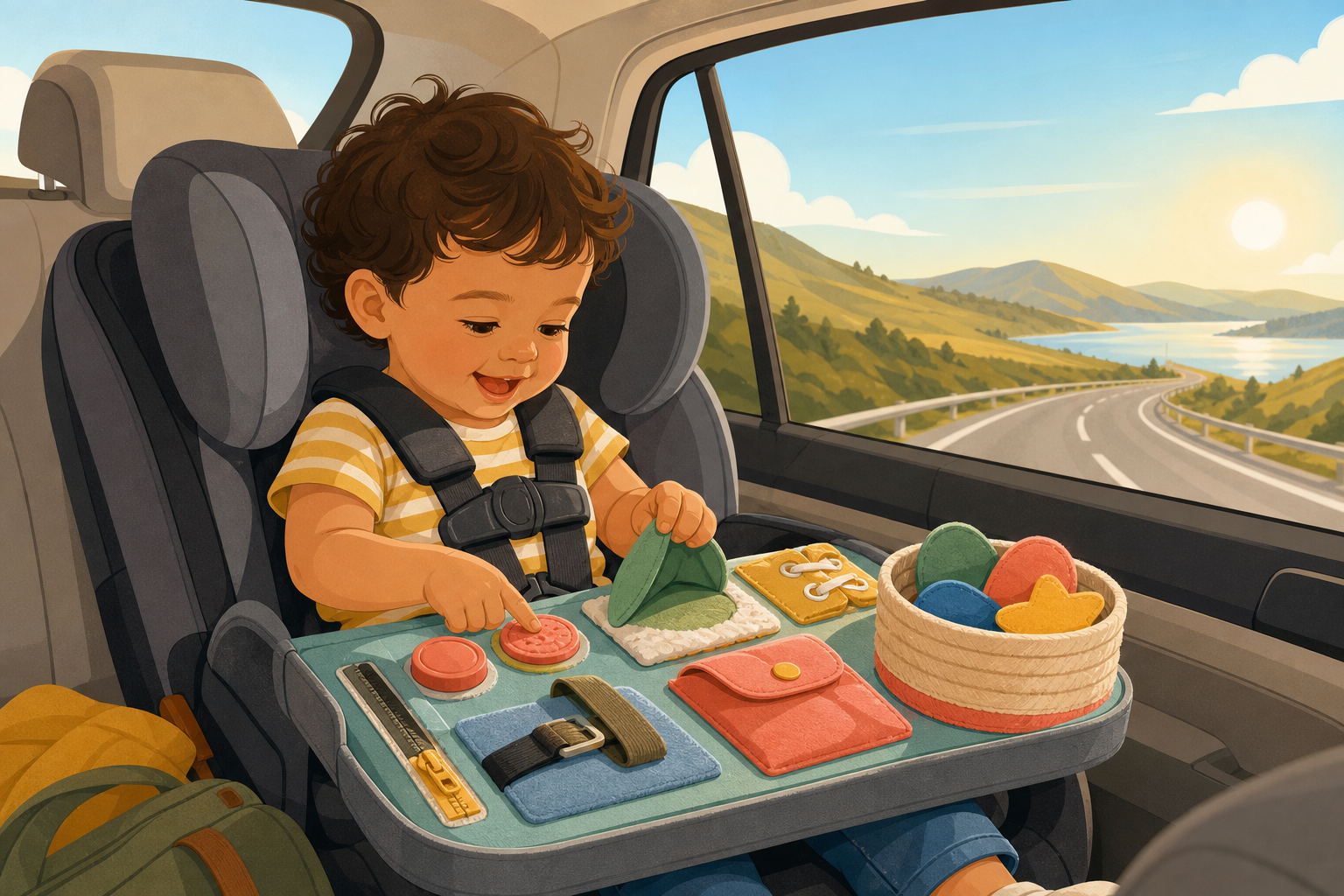
2. Felt or sticker scene board. A small felt board or reusable sticker pad where pieces stick and peel lets a toddler build the same scene twenty times in a row. No instructions required after the first demo, which takes about 15 seconds.
3. Texture bag. Fill a drawstring bag with five or six distinct objects: a pom-pom, a small car, a rubber ring, a pinecone, a smooth stone. The toddler reaches in, pulls one out, feels it, names it if they can talk, and puts it back. This is entirely self-directed.
4. Picture scavenger pouch. Instead of a written scavenger hunt list, use a small deck of picture cards (a red car, a cow, a truck, a stop sign). The toddler holds the cards and looks for the matching thing out the window. No reading, no writing, just looking and pointing.
5. A quiet fidget or lacing toy. Something with repetitive motion, like a lacing card with big holes and a thick cord, or a bead maze, keeps hands busy without any cognitive load at all.
Rotate these every 15 to 20 minutes. You do not need to introduce anything new, just hand over the next pouch. The predictability is actually part of what makes it work for this age.
Setting Up So You Rarely Have to Help
The setup matters more than the activities themselves. Before you leave:
- Put each activity in its own clear pouch or small bag, labeled with a picture (not a word) of what's inside.
- Keep all five pouches in a single container within arm's reach of the car seat, not the trunk.
- Do a 30-second demo of each activity at home before the trip, not in the car. This is the only explanation your toddler needs; repetition in the car will not require new instructions.
- Skip anything with small loose pieces that can disappear under a seat. If it has more than 10 pieces, it is probably going to end up as a tantrum trigger, not a quiet activity.
If you are coordinating this for more than one kid at different ages, the pouch system also works well alongside ideas in how to keep siblings of different ages entertained on a long car ride, since older kids can have their own rotation running in parallel without needing your attention either.
What to Do When the Rotation Stops Working (Mile 200)
Even a good system runs out of steam. When your toddler starts throwing pouches instead of using them, these are the sanity-saving backups:
- Snack pacing, not snack dumping. Give one small snack every 20 to 30 minutes instead of a full bag at once. The act of opening a new snack resets attention the same way a new toy would.
- Window narration. Point at something and name it yourself; toddlers often watch and listen even if they cannot talk back much yet. This buys 5 to 10 minutes with zero prep.
- A short walk at the next stop. Non-readers at this age are also pre-verbal in terms of explaining they need to move. A 5-minute stretch at a rest stop often resets 45 minutes of car time.
- A printable coloring page. For the quietest moments, printable coloring pages from Chunky Crayon are a mess-light option that needs almost no setup and nothing to read, just color inside or outside the lines, whichever way your toddler feels like it that day.
If the meltdown is about an unexpected stop or detour rather than boredom, a visual schedule for unexpected routine changes can help a toddler understand the trip is not going the way they expected, even before they have the words to ask why.
Packing the Kit So It Actually Gets Used
A great activity system does nothing if it is buried under luggage. Pack the activity pouches last, in a small bag that goes on the floor of the back seat or in a seatback organizer, never in the trunk. If you are also managing multiple kids' bags and worried about overpacking the car, the approach in how to get kids to pack their own suitcase applies here too: smaller, labeled, and separated by purpose beats one giant bag every time.
The Bottom Line
A non-reading toddler does not need more activities, they need activities that do not require you to explain anything twice. Build a small rotation of five visual, repeatable, low-mess options, demo them once before you leave the driveway, and let the predictability do the work. When the rotation runs dry, snacks, a short stretch, and a quiet coloring page will usually get you to the next exit.
If you want a ready-made version of this kind of rotation sorted by age and trip length, Kids Road Kit generates a free printable pack you can throw in the car without building the pouches yourself.