October 26, 2026
Screen-Free Long Flight Activities for Kids Ages 2 to 10
Flying solo with kids ages 2 to 10? Try this screen-free activity rotation and airplane bag ideas to keep siblings busy and calm the whole flight.
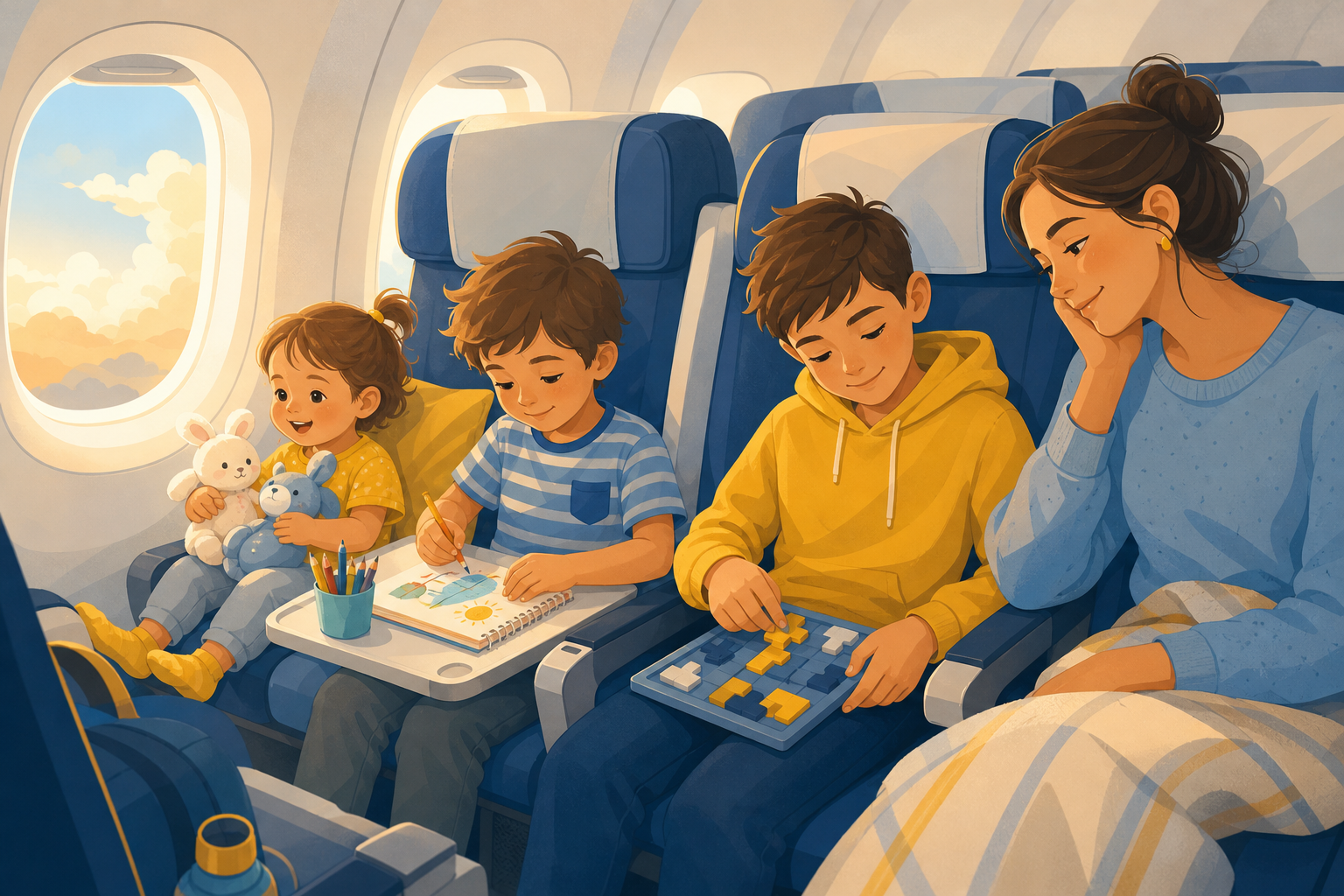
How to Keep Siblings Ages 2 to 10 Busy on a Long Flight Without Screens: A One-Adult Activity Rotation for Different Ages
You've got a 2-year-old who wants out of her seat every eleven minutes, a 6-year-old who needs constant redirection, and a 10-year-old who's "bored" within the first hour. You're the only adult. The seatbelt sign just turned off for a five-hour flight, and you haven't even taken off your coat yet.
Most airplane activity lists assume one kid, one bag, and a parent with two free hands. That's not your flight. When you're solo with siblings spanning three developmental stages, the problem isn't finding activities, it's managing who gets your attention when, so nobody melts down while you're helping someone else.
Why One Shared Activity Bag Doesn't Work
A single bag of airplane activities for siblings sounds efficient, but in practice it creates fights over whose turn it is, and it ignores the fact that a 2-year-old and a 10-year-old need completely different things from you. The toddler needs your hands. The school-age kids need your eyes, occasionally, and mostly need to not be interrupted by a toddler grabbing their stuff.
The fix is a travel activity pouch for each kid, prepped before boarding, plus a rotation schedule that tells you (not them) whose turn it is for hands-on help. This turns a chaotic flight into something closer to a system you can run on autopilot, even sleep-deprived.
Build Three Pouches, Not One Bag
Pack a separate quart-size bag or pouch per child, labeled with their name. Each pouch should be small enough to live in the seatback pocket and specific to that kid's age and attention span.
Toddler pouch (ages 2 to 4):
- Reusable sticker book (peel-and-stick, no mess)
- A small busy box: zipper pulls, a mini lock and key, buttons to snap
- One "surprise" wrapped item you reveal mid-flight (a $1 toy works)
- Board book, two max
- Snack pouch with a built-in spout so there's less spillage
If your toddler isn't reading yet, screen-free road trip activities for non-reading toddlers translate almost directly to a plane seat since the core need (tactile, repetitive, low-mess) is identical.
School-age pouch (ages 5 to 7):
- Dry-erase travel board with a cloth
- Dot-to-dot or maze books
- A small set of magnetic travel checkers or tic-tac-toe
- Window clings for the plane window (quiet and reusable)
- A notepad for "I Spy" style lists they can do solo
Big kid pouch (ages 8 to 10):
- A logic puzzle book (sudoku, word search, crosswords)
- A deck of cards with two or three game rules written on an index card
- A small notebook for a travel journal or comic-drawing project
- Origami paper with simple folding instructions
- Printable coloring pages from Chunky Crayon are a quiet, mess-light option that works for this age group too, especially if you print a few before you leave the house.
The Rotation: Who Gets Your Hands, and When
Here's the part most lists skip. Pack the pouches, sure, but also decide ahead of time how you'll split your attention across three kids who all need different amounts of it.
Use a loose 15-to-20 minute rotation:
- Minutes 0 to 20: Settle the toddler first. Toddlers melt down fastest and recover slowest, so get them engaged with something hands-on while the older two start their pouches independently.
- Minutes 20 to 40: Shift to the 5 to 7-year-old. Check their dot-to-dot, start a quick game if they want one, but keep it short. Meanwhile glance over at the toddler every few minutes rather than hovering.
- Minutes 40 to 60: Check in with the 8 to 10-year-old. At this age, kids often just want you to notice what they made or solved, not play with them the whole time. A quick "show me" moment usually resets their patience for another 20 minutes solo.
- Repeat, but swap the order. Starting with a different kid each cycle means nobody's always last in line for your attention, which cuts down on the "it's not fair" complaints.
This isn't a strict stopwatch schedule. It's a mental anchor so you're not reactively bouncing toward whoever is loudest. If you've used a reward chart to manage sibling squabbles at home, the same idea applies here: a predictable structure reduces competition for attention a lot more than winging it does. If that's a recurring issue in your house, a printable reward chart fix for sibling fighting carries over surprisingly well to travel days.
Swap Activities Before They Get Bored, Not After
The single biggest mistake with airplane activities for toddlers and school-age kids alike is waiting for "I'm bored" before introducing something new. By then you're playing catch-up with a kid who's already dysregulated.
Instead, swap each child's main activity every 15 to 20 minutes, even if they haven't fully finished it. Rotate: quiet toy, then snack, then a drawing or puzzle, then a short game with you, then a book, then repeat. The specific order matters less than the rhythm. Predictable change keeps attention fresher than any single toy, no matter how novel it is.
Keep one or two items completely hidden until hour three or four. A fresh sticker pack or a new puzzle book feels like a big deal precisely because nothing else on the flight is new anymore.
When It Falls Apart Anyway
It will, at some point, for at least one kid. Build in a release valve:
- A short walk to the galley or bathroom resets a toddler's body when sitting still stops working.
- Let the 8 to 10-year-old use headphones for an audiobook or music during the toddler's hardest stretch. This isn't a screen, and it buys you both hands for a few minutes.
- If a meltdown starts, address the most escalated kid first and let the others know explicitly, "give me two minutes with your sister, then I'm coming to see your maze." Naming the wait out loud reduces the sense of being ignored.
If your flight connects through a layover, the same pouch-and-rotation system works in the terminal too. A two-hour airport wait is really just a flight without the seatbelt sign, and planning for that stretch separately helps, since gate areas have more room to move but also more ways to wander off.
The Real Goal
You're not trying to entertain three kids perfectly for six hours straight. You're trying to avoid the moment where all three need you simultaneously. A labeled pouch per kid, a loose rotation, and a couple of held-back surprises won't make the flight easy, but they'll keep it from becoming the flight everyone still talks about at Thanksgiving.
Print your own screen-free kit before you go, tailored to each kid's age and the length of your flight, and pack it the night before so it isn't one more thing you're scrambling for at the gate.