June 29, 2026
Screen-Free Road Trip Activities for 8-10 Year Olds
Discover engaging screen-free travel activities for 8 to 10 year olds that skip the baby games. Real solutions for keeping big kids entertained on long drives.
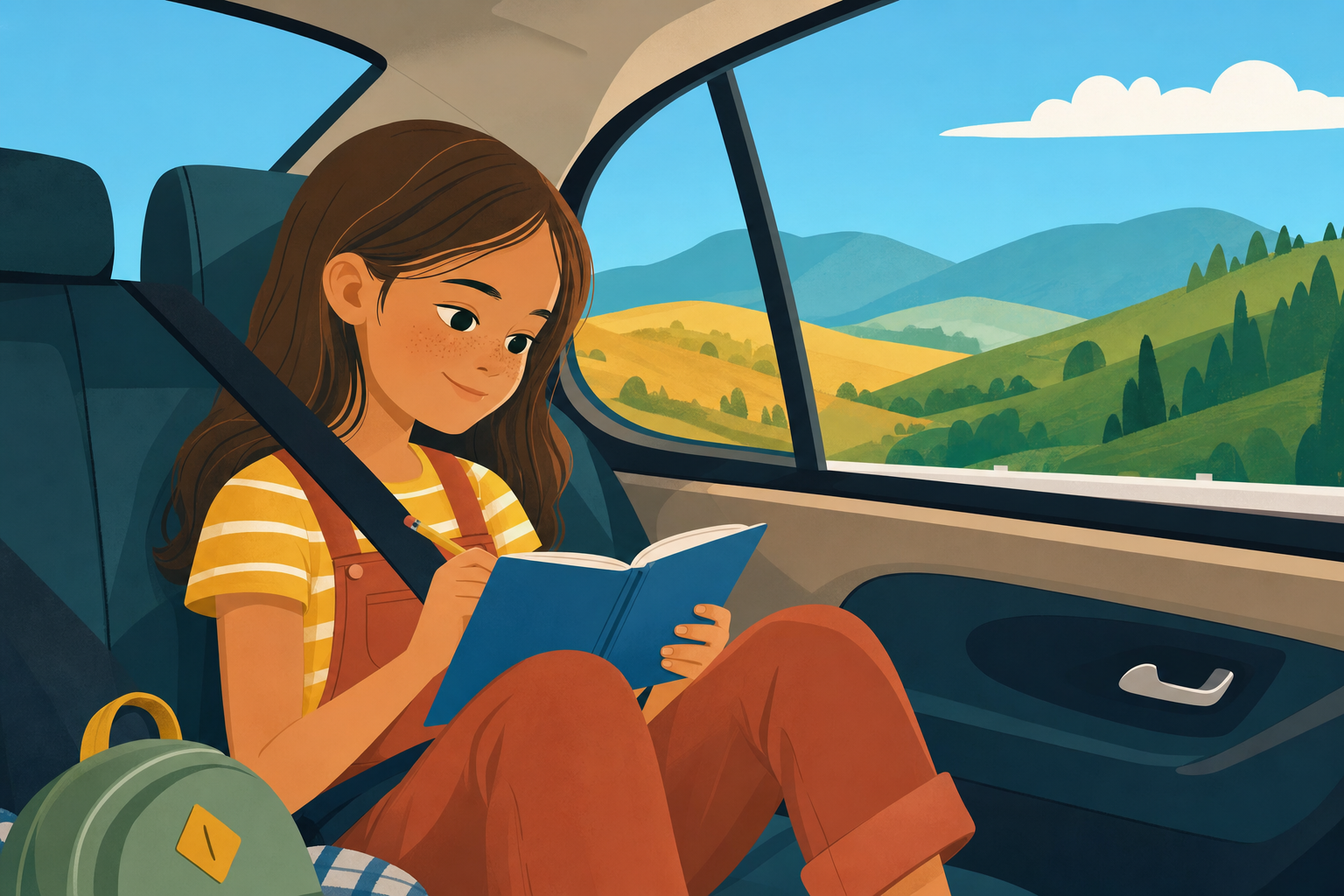
High-Engagement Screen-Free Road Trip Activities for 8 to 10 Year Olds (No Coloring, No Baby Games)
Your 9-year-old just announced they're "too old for this baby stuff" 45 minutes into a five-hour drive, and the coloring books you packed are untouched on the floor. You need screen-free travel activities for 8, 9, and 10 year olds that don't feel like preschool hand-me-downs, and you need them now.
The gap between "toddler car games" and "just hand them a tablet" is real. Kids this age want challenge, strategy, and social interaction that doesn't treat them like babies. Here's what actually works when you're facing hours in the car with a bored big kid who's outgrown bingo and sticker books.
Why Standard Road Trip Activities Fail for 8 to 10 Year Olds
Most road trip game lists were written for preschoolers. Your 8-year-old doesn't want to color or play I Spy with colors. They want competition, complex rules, and activities that feel legitimately interesting.
The developmental shift is huge. Eight to ten year olds can handle multi-step strategy, delayed gratification, and abstract thinking. They're also deeply aware of what feels "babyish," and they'll shut down hard if an activity insults their intelligence.
You're not looking for busy work. You're looking for what to do with a bored 9 year old on a car ride when screens aren't an option and they've rejected everything else.
Story-Building Games That Actually Require Thinking
Forget "once upon a time" round-robins. Try Consequences, a Victorian parlor game that's survived because it's genuinely funny. Each person writes one line of a story on paper, folds it to hide what they wrote, and passes it. Prompts rotate: "Character 1's name," "met Character 2's name," "at this location," "Character 1 said," "Character 2 said," "and then this happened," "and the consequence was."
Unfold and read the chaos aloud. The nonsense combinations ("Abraham Lincoln met a cafeteria lunch lady at the bottom of the ocean. He said, 'I forgot my homework.' She said, 'That's my favorite song.' They started a detective agency, and the consequence was everyone had to wear socks on their ears") land differently than preschool Mad Libs. It's absurdist humor for kids who are old enough to get the joke.
20 Questions with a Constraint adds strategy. Standard 20 Questions gets stale. Add a rule: the answerer must pick something visible from the car window right now, or something that happened on this trip so far. Suddenly it's not abstract guessing. It's observation, memory, and gotcha moments when someone picks "that weird barn we passed 20 minutes ago."
For solo entertainment (when siblings are asleep or you're driving alone with one kid), try License Plate Storytelling. Every license plate they spot becomes a character's initials and a plot point. "BXR 4829" becomes "Barry Xavier Rodriguez, age 48, who lives at 29 Oak Street and has 2 pet ferrets and 8 chickens." String five plates into one weird story. It's creative writing that doesn't require pencils or looking down (which helps kids prone to carsickness).
Strategy Games That Work Without a Board
Screen-free car games for 8 to 10 year olds need stakes. Try Ghost, a spelling game that's part bluff, part vocabulary flex. Players take turns adding one letter to a growing word fragment, trying not to complete a word. If you finish a word (four letters or longer), you lose the round. If you think the other player is bluffing (adding a letter that can't make a real word), challenge them. If they can't name a valid word their fragment could become, they lose. If they can, you lose.
Example: Player 1 says "S." Player 2 adds "T" (thinking "STOP"). Player 1 adds "R" (thinking "STRONG"). Player 2 adds "A" (thinking "STRANGE"). Player 1 says "N" (thinking "STRAND"). Player 2 adds "G" and completes "STRANG..." wait, that's not a word unless they add an E, which would complete STRANGE and they'd lose. The strategy is in steering toward words only you know.
It's ruthless. It rewards big vocabulary. It feels nothing like baby games.
Contact is similar but for word associations. One player thinks of a word and announces the first letter. Other players try to guess by giving clues for words that start with that letter, without saying the word. If two players figure out the same word from a clue, they shout "Contact!" and count down from three, saying the word in unison. If they match, the first player must reveal the next letter. Example: Secret word is DRAGON. First letter is D. Player 2 says, "Is it something you do in a pool?" Player 3 realizes it's DIVE and shouts "Contact!" They count down and both say "DIVE!" Now the first player has to reveal the second letter: R. Game continues until someone guesses DRAGON or the whole word is revealed.
Both games require zero supplies and keep multiple kids engaged without devolving into "your turn, my turn" boredom.
High-Stakes Scavenger Hunts (Not the Toddler Version)
Standard car bingo is too easy for this age. You need Rare Item Scavenger Hunts with point values. Create a list (mentally or on paper before the trip) with common items worth 1 point (red car, speed limit sign) and rare items worth 10-50 points (out-of-state license plate from Alaska, a car pulling a boat AND a trailer, someone wearing a costume in another car, a billboard for something that doesn't exist anymore).
The hunt isn't "find these things." It's "find the highest point total in the next 30 minutes." That's competition.
For trips with multiple legs, try Photo Evidence Scavenger Hunts (if phones are allowed for photos but not entertainment). List absurd combos: "A gas station with a name that sounds made up," "a building that looks like it's from a different century than the ones around it," "the weirdest roadside statue." Kids take photos as evidence. Review at rest stops and argue about which one wins.
If you're planning a longer journey with overnight stops, the strategies in our post on keeping kids entertained on long car rides with hotel stops can be adapted upward. The core idea (segmenting the trip into challenge blocks) works even better with older kids who can track their own progress.
Travel Journals That Aren't Arts and Crafts
Travel activities for older kids (no coloring, no babyish prompts) can include journaling if you frame it right. Skip "Draw what you see" or "Write about your favorite part of the day." Those feel like homework.
Try Overheard Dialogue Logs. Every weird sentence fragment they hear at a rest stop or gas station goes in the journal. "I told him the raccoon was a bad idea." "It's not stealing if it's from a vending machine." At the end of the trip, they have a bizarre collection of real human sentences to use in future stories.
Rest Stop Reviews work too. Rate every rest stop, gas station, or restaurant on a scale (bathroom cleanliness, snack selection, weirdness factor). Add a one-sentence review. "This place had a vending machine that sold live bait. 10/10, would stop again." It's observational writing that doesn't feel like a school assignment.
For quiet focus time, printable coloring pages from Chunky Crayon work if your kid is in the mood for art, but if they're in the "no coloring" phase, these journal formats give them a similar creative outlet that feels more mature.
Route Mapper is hands-on without being babyish. Give them a blank notebook and have them draw a stylized map of the route as you drive, marking landmarks, weird signs, and memorable stops. Not realistic cartography. Stylized, video-game-style maps with labels. "Here There Be Cows." "The Rest Stop of Despair." "The World's Saddest Playground." It's creative, observational, and something they'll actually want to keep.
Word Games That Require Real Strategy
What to do with a bored 9 year old on a car ride when they're too old for Alphabet Game? Try Category Countdown. Pick a category (dog breeds, countries, pizza toppings, video game characters). Set a timer (or pick a landmark: "before we pass the next exit"). Everyone rapidly names items in that category. No repeats. First person who hesitates or repeats loses.
Speed matters. The pressure makes it fun.
Fortunately/Unfortunately is improv training disguised as a game. One player starts a story: "Fortunately, we found a treasure chest." Next player adds a problem: "Unfortunately, it was full of angry bees." Next player fixes it: "Fortunately, we were all wearing beekeeper suits." Next player wrecks it: "Unfortunately, the suits were made of honey."
It's quick, it's funny, and it rewards clever thinking. The best part? It works with two players or five, and younger siblings who are listening will want to join (or at least stop whining because they're entertained by the chaos).
Rhyme Battles are brutal and hilarious. Pick a word. Players take turns saying a word that rhymes. No repeats, no nonsense words, no pausing longer than three seconds. Last player standing wins. Start easy ("cat") and move to absurd ("orange," which technically has no perfect rhymes, so you argue about near-rhymes like "door hinge" and it becomes a debate about linguistics).
These screen-free road trip activities for big kids (no screens, no art supplies) work because they respect your kid's intelligence. They're not dumbed down. They're strategic, social, and weird enough to hold attention past the first ten minutes.
When Nothing Is Working
Sometimes the issue isn't the activity. It's that your kid needs to move, and they've been strapped in a seat for three hours. No game will fix that. You need a rest stop with space to sprint, not another round of 20 Questions.
If your child struggles with long stretches of enforced stillness (and most 8 to 10 year olds do), building in regular movement breaks isn't optional. The same principle from our post on building independent play routines applies here: you can't expect sustained focus without physical resets. For car trips, that means planning stops every 90 to 120 minutes where the only agenda is "run in circles until you're less feral."
And if all else fails? Sometimes the most honest answer is "this part of the trip is boring, and that's okay." Not every moment needs to be optimized. Sometimes boredom is just part of getting from Point A to Point B, and teaching kids to sit with that (without a meltdown or a screen) is a skill too.