June 24, 2026
Screen-Free Road Trip Activities for 8-Year-Olds (No Art!)
Discover engaging, low-prep car games and boredom busters perfect for 8 to 10 year olds on long drives. No coloring books or baby games, just activities big kids actually enjoy!
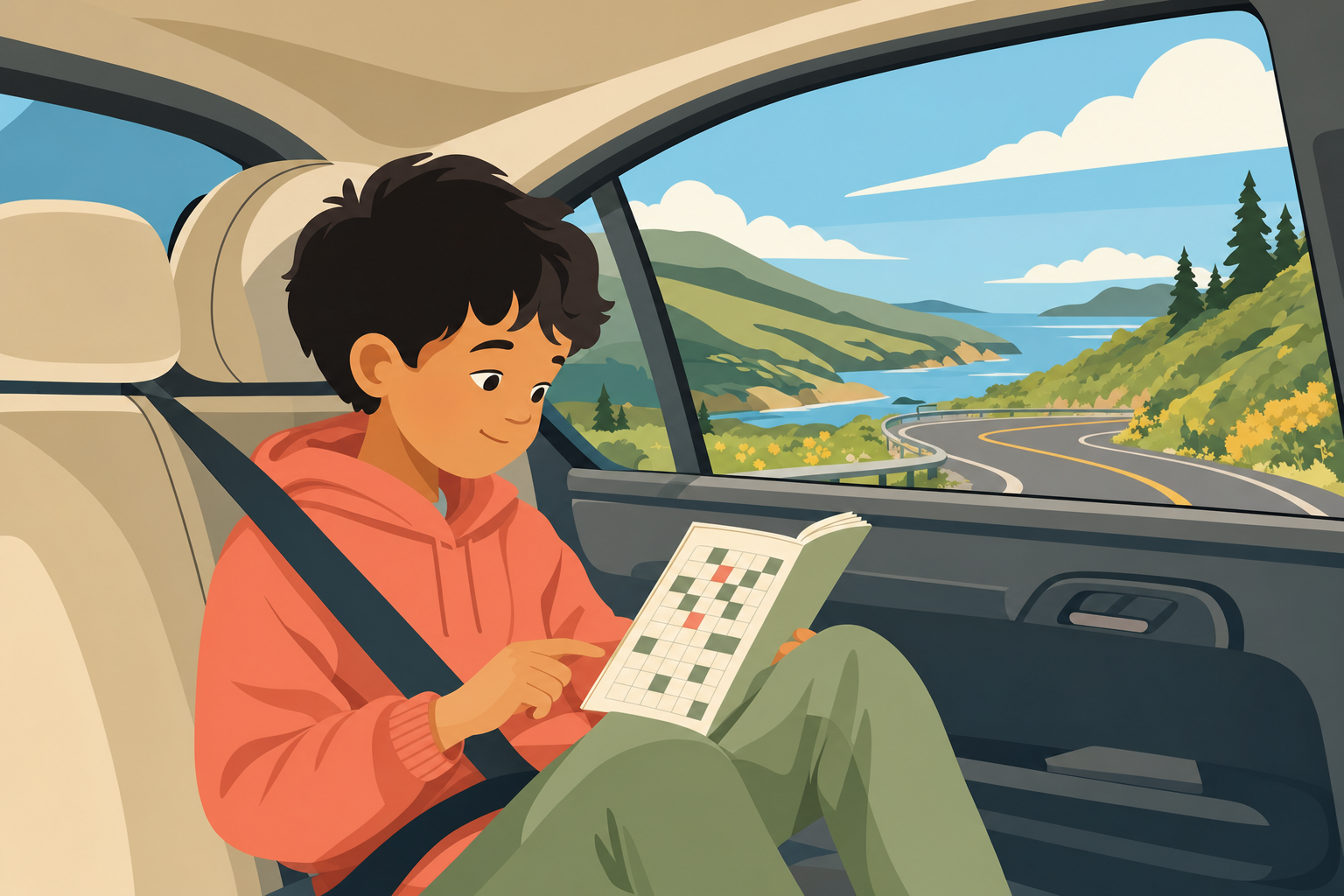
High-Engagement, Non-Art Screen-Free Road Trip Activities Specifically for 8-Year-Olds (and 8-10 Age Range) That Avoid Coloring, Stickers, and 'Baby' Games
Your 8-year-old just announced they're bored, you're 90 minutes from the next rest stop, and the last time you handed them a coloring book they rolled their eyes so hard you worried they'd sprain something.
Most screen-free road trip activities for 8 year olds miss the mark because they're designed for preschoolers. Your third-grader doesn't want stickers or alphabet games. They want challenges that feel grown-up, stories they can build, and puzzles they have to actually think about.
Here's what works when you need car games for 8 year old without screens that respect the fact that they're capable of real strategy, creative thinking, and sustained attention spans.
Why Standard 'Screen-Free' Lists Don't Work for 8-Year-Olds
Eight-year-olds are in a weird in-between zone. They're past the developmental stage where peek-a-boo or I Spy colors hold any appeal, but they're not yet teenagers who can entertain themselves for hours with a podcast.
They can read chapter books, understand complex rules, and hold multi-step strategies in their heads. They're also deeply aware of what feels babyish, and they'll shut down the second an activity feels beneath them.
That's why most generic road trip activity lists bomb with this age group. Water Wow books, foam stickers, and "find the red car" games were great at age 4. At 8, they need something with actual depth.
Storytelling Games That Build On Themselves
Low-prep travel activities for big kids 8-10 work best when they have a narrative thread that continues across the trip. These aren't one-and-done games. They're ongoing stories that get richer the longer you play.
Desert Island Survival: Each person picks five items they'd bring to a deserted island (no obvious choices like "a boat" or "a satellite phone"). Then spend the rest of the drive collaboratively building the story of how you'd survive using only those items. The trick is that everyone has to agree on the rules of the island (Are there coconuts? Wild animals? Freshwater?), and then you have to solve problems together using only your combined ten items.
This game can stretch across hours because new problems keep arising. How do you build shelter? What happens when it rains? A kid with a Swiss Army knife and another with a tarp suddenly have to negotiate who's in charge of construction.
Sequel Writing: Pick a movie or book your kid knows well (Harry Potter, Encanto, whatever). Now you're writing the sequel together, taking turns adding one sentence at a time. The rule is you can't contradict what's already been said, so the story gets increasingly absurd and complex as you go.
An 8-year-old will stay locked in on this for 45 minutes if the stakes get high enough. When you get to a boring stretch of highway, this is the kind of road trip boredom busters for 8 year old no coloring that actually holds attention.
Logic Puzzles You Can Play Out Loud
Big kids love feeling smart. Give them puzzles that require actual reasoning, not just guessing.
20 Questions (Competitive Version): Standard 20 Questions is fine, but add a twist. The person answering can lie once during the game. The questioners have to figure out when the lie happened and call it out. If they catch the lie, they get an extra five questions. If they don't, the answerer wins.
This turns a simple guessing game into a strategic challenge. Your 8-year-old has to track all the previous answers, notice contradictions, and decide when to use their accusation.
Category Countdown: Pick a category (types of dogs, U.S. states, pizza toppings). Set a timer for 60 seconds (or just count in your head). Each person has to name something in that category, going back and forth, without repeating. First person who hesitates for more than three seconds loses that round.
The brilliance here is that the first few are easy (golden retriever, California), but by round three you're both scrambling to remember the obscure ones (Catahoula leopard dog, Delaware). It's what to do with an 8 year old on a long car ride screen free when you need something that cycles quickly but stays engaging.
Two Truths and a Lie (Road Trip Edition): Everyone states three "facts" about something you can see from the car (a barn, a billboard, the car in front of you). Two are made-up, one is arguably true. The other players have to guess which one is real.
"That barn has 14 windows, it was built in 1987, and it's exactly 40 feet tall." Now your kid has to actually look at the barn and use logic to figure out which statement could be verified or debunked.
Word and Memory Challenges That Scale Up
These aren't alphabet games. They're pattern-recognition and memory exercises that get harder as you go.
Fortunately, Unfortunately: This is an old improv game. One person starts a story with a sentence beginning with "Fortunately." The next person continues with "Unfortunately." You alternate, building a story that swings wildly between good and bad luck.
"Fortunately, we found a hidden treasure chest."
"Unfortunately, it was full of angry bees."
"Fortunately, we were wearing beekeeper suits."
"Unfortunately, we forgot to zip them up."
It sounds simple, but the challenge is keeping the story coherent while flipping the tone every sentence. An 8-year-old will stay engaged because they're trying to one-up your last twist.
Rhyme Chain: Pick a word (say, "park"). The next person has to say a word that rhymes ("dark"). Then the next person says another rhyme ("shark"). No repeats. First person who can't think of a new rhyme loses.
Once someone loses, pick a new starting word. This game moves fast, doesn't require props, and gets surprisingly competitive when you've burned through the obvious rhymes and someone drops "oligarch" just to show off.
Story Ingredients: One person picks three random "ingredients" (a purple elephant, a broken skateboard, a thunderstorm). The other person has to tell a two-minute story that naturally includes all three. Then switch roles with new ingredients.
This forces creativity under pressure. Your 8-year-old can't just phone in a lazy story because the ingredients don't connect. They have to build a plot that makes all three elements feel necessary.
If you're on a longer trip with multiple stops, rest stop bathroom break activities can give you a physical-movement reset between these mental games.
Number and Strategy Games That Don't Need Paper
The Counting Game: Both players start at 1 and count up together, taking turns. The catch: each person can say one, two, or three numbers on their turn. Whoever gets stuck saying "21" loses. Then you play again, trying to force the other person into the losing position.
This is strategic. Once your kid figures out the pattern (you want to land on 17, then 13, then 9, then 5, then 1), they feel like a genius. You can change the losing number (31, 50, whatever) to keep it fresh.
Botticelli: One person thinks of a famous person (real or fictional, but someone the other player would know). They announce the first letter: "I'm thinking of someone whose name starts with M." The guesser asks yes/no questions, but they have to phrase them as "Are you..." with a specific person in mind.
"Are you a wizard with a long white beard?" (Merlin)
If the answerer can't figure out who you meant, you get to ask a direct question: "Are you real?" or "Are you alive?" If they do figure it out ("No, I'm not Merlin"), you have to try again with a different M-person.
This game works beautifully for screen-free car games for 8 year old without screens because it requires real knowledge and clever question-phrasing. It's not babyish, and it rewards kids who read and pay attention to the world.
When you need a quieter option that still engages their hands without feeling like arts and crafts, printable coloring pages from Chunky Crayon work as a calm-down activity between higher-energy games. But for sustained engagement, the verbal games above are the backbone of long stretches.
How to Rotate Activities Without Losing Momentum
The mistake most parents make is burning through all their good ideas in the first hour. Then you're stuck with nothing for the next three.
Instead, rotate game types. Play one storytelling game, then one logic puzzle, then one word game, then a strategy game. This keeps the mental muscles switching so nothing gets stale.
Set a loose timer (even if it's just "we'll play this until we pass the next town"). When an activity starts dragging, cut it and move to the next one. Don't force a game past its natural endpoint just because you're mid-round.
And here's the real trick: let your 8-year-old pick the next game from your list. Big kids hate feeling like everything is dictated to them. Giving them choice (even fake choice between two options you're both fine with) makes them way more cooperative.
If you're planning a longer trip with mixed-age kids, mixed age birthday party ideas has strategies for activities that work across developmental stages without making anyone feel left out.
When the Car Goes Quiet (And That's Okay)
Not every minute needs to be filled. Eight-year-olds are old enough to zone out and daydream for stretches, especially if they've been actively engaged for the past hour.
If your kid goes quiet and stares out the window, that's not a crisis. That's their brain processing. Let them have that space.
The goal isn't non-stop entertainment. It's having enough high-quality options that the trip doesn't devolve into "I'm bored" whining every 20 minutes. These low-prep travel activities for big kids 8-10 give you a deep bench so you're never scrambling.
Pack a short list of these games in your phone's notes app or scribble them on an index card you keep in the console. When the next "I'm bored" hits, you'll have ten options that respect the fact that your kid is smart, capable, and way past the age where a sticker book is going to cut it.