July 10, 2026
Screen-Free Travel Activities for 8-10 Year Olds: 30+ Minutes
Discover engaging, independent activities that keep 8 to 10 year olds entertained for 30+ minutes on long car trips. No screens, no nagging required.
Long-Duration, Independent Screen-Free Travel Activities Specifically for 8 to 10 Year Olds (Ages 8 to 10) That Last 30+ Minutes Without Parental Nagging
Your 8-year-old just announced she's bored. Again. You're two hours into a six-hour drive, and the toddler tricks that worked last year (stickers, I Spy, simple coloring) now get an eye roll. She's too old for baby games but still needs something to do that doesn't involve a screen or you playing cruise director from the front seat.
The gap between "little kid" activities and true independent reading is real. Eight to ten year olds have the focus for longer tasks, but they need the right kind of challenge. They want activities that feel grown-up, have some complexity, and don't require you to facilitate every three minutes.
Here's what actually works for 30+ minutes of independent engagement.
Travel Journal With Structured Prompts (Not Just Blank Pages)
A blank journal sounds good in theory. In practice, most kids stare at the empty page for two minutes and give up.
Instead, give them a travel journal with specific missions. Before the trip, write or print prompt pages: "Draw the weirdest billboard you see," "Write a restaurant review of our lunch stop," "Sketch three different license plate designs," "Describe the landscape in exactly 50 words."
The structure keeps them moving. They're not inventing from nothing; they're responding to assignments that feel official. Add a small prize (choosing the next snack stop, picking tomorrow's breakfast) for completing five entries, and you've got 45+ minutes of quiet focus.
One parent keeps a "road reporter" kit: a small binder with page protectors holding prompt sheets, a pen on a string, and a ziplock of interesting magazine cutouts for collage inspiration. Her 9-year-old treats it like a job.
Logic Puzzle Books (Not Sudoku for Adults)
Sudoku is too hard for most 8-year-olds, and word searches feel like homework. Look for age-appropriate logic puzzle books: mazes with rules ("only step on prime numbers"), pattern detection grids, visual brain teasers, and story-based mystery puzzles where they decode clues.
Brands like Highlights, Brain Quest, and Usborne make puzzle books specifically for this age that ramp up difficulty slowly. The best ones mix puzzle types so the kid isn't doing the same thing for an hour straight.
Keep the book in the car only. Scarcity makes it more appealing. If it's always available at home, it becomes wallpaper.
Map-Based Role Playing Games They Run Solo
Give your 8-year-old a paper map of your route (print from Google Maps or grab a free state highway map). Before you leave, add fictional elements: "There's a secret agent meeting in the town we're passing at 2pm. What's their cover story?" or "Mark three places where a dragon might hide. What would each one eat?"
They're not just passively riding. They're tracking your real progress and layering an imaginary adventure on top. Some kids narrate quietly to themselves. Others draw on the map. Either way, it's 40+ minutes of independent, creative focus.
For kids who like structure, create a simple character sheet (name, special skill, mission objective) and let them write updates as you pass landmarks. "We just crossed the river. My character found a clue in the water: a silver coin with a hawk on it."
This isn't a game you're playing with them. You're handing them the tools and letting them build the world.
Collaborative Story Writing With Plot Twists (Pass the Notebook)
If you have two kids in the 8 to 10 range, or an older kid willing to play with a younger sibling, the pass-the-notebook story game works beautifully.
Start a story with two sentences: "The van broke down in the middle of nowhere. When we opened the hood, we found something impossible." Hand the notebook to kid one. They write the next two to three sentences and pass it to kid two. Back and forth.
The rule: every handoff must include a plot twist or new character. No ending the story for at least ten passes.
This works because they're entertaining each other, not you. Siblings who bicker over everything will collaborate on making the story as ridiculous as possible. You'll hear giggles from the back seat as they try to one-up each other's twists.
One variation: the story must include every road sign you pass. "Next person has to work in 'Dairy Queen' and 'Left Lane Ends.'"
Long-Form Building Projects With Travel-Sized Supplies
Legos spill. Craft kits make a mess. But there are building toys designed for travel that an 8 to 10 year old can work on for an hour without losing pieces.
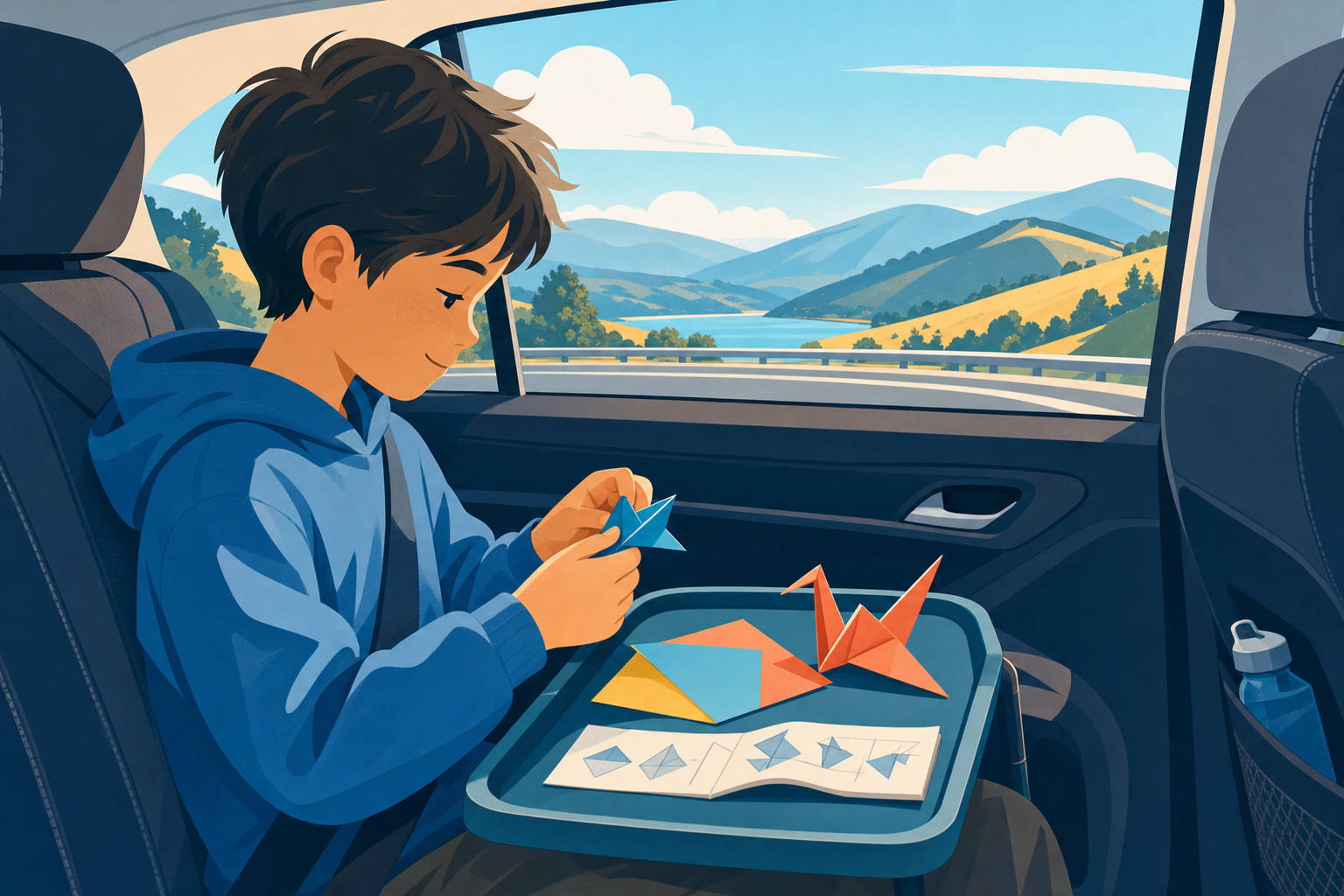
Look for magnetic building tiles in a zippered case, pipe cleaner sculpture kits with a project book, or origami sets with instructions for 20+ designs. The key is a contained system with enough complexity to stay interesting.
Printable coloring pages from Chunky Crayon are a quiet, mess-light car activity if your kid likes detail work. Pair with a pencil case of fine-tip markers (not the fat toddler kind) and they'll zone out for 30 minutes on a single intricate design.
The project needs to feel challenging enough that completing it is an accomplishment. If it's too easy, they'll finish in ten minutes and be bored again.
Audio Drama Series (Not Music, Not Audiobooks)
Audiobooks require focus that's hard in a noisy car. Music gets old. Audio drama series, the kind with sound effects and multiple voice actors, hit differently.
Shows like Story Pirates, The Unexplainable Disappearance of Mars Patel, or Circle Round have 20 to 40 minute episodes that feel like watching a show with your eyes closed. Kids this age can follow complex plots, and the episodic structure means natural break points.
Download three to four episodes before the trip. Let your kid control playback with their own cheap mp3 player or old phone in airplane mode. The independence matters. They're not asking you to skip ahead or restart; they're managing their own entertainment.
Pair with a sketchbook. Some kids like drawing scenes from what they're hearing. It doubles the engagement time.
Interview Project (They Interview You or Siblings)
Give your 8 to 10 year old a list of interview questions and a recording app (or just a notebook). Their job: interview everyone in the car and compile the answers.
Sample questions: "What's the first thing you remember from a road trip?" "If you could add one stop to this trip, where?" "What's the weirdest food you've ever eaten while traveling?" "Describe our family in three words."
They're practicing conversation skills, writing or recording, and feeling like they're doing something important. Bonus: you get a record of the trip from their perspective.
Some families make this an annual tradition. The kid becomes the "trip historian" and keeps all the interviews in a binder at home. Comparing answers across years becomes part of the activity.
If you need more ideas for keeping younger kids engaged without screens, our post on screen-free car activities for kids who get carsick covers strategies that work when reading isn't an option.
Scavenger Hunt With Photo Evidence (Uses Your Phone as a Tool, Not a Screen)
This isn't a toddler scavenger hunt ("find something red"). It's a photography assignment.
Before the trip, write a list of 15 to 20 specific things to photograph: "A water tower," "Someone wearing a hat in another car," "A road sign with an animal on it," "Three different state license plates," "A building older than 100 years."
Hand them your old phone (camera only, no service needed) or a cheap digital camera. They're hunting and documenting. At rest stops, they can review their photos and check items off the list.
The challenge keeps them watching out the window. They're not zoning out; they're scanning for targets. And you're not handing them a phone to scroll social media. You're giving them a camera with a mission.
One dad adds a point system: common items (gas station) are worth one point, rare items (bald eagle, airplane in the sky) are worth five. Kid with the most points by the destination picks the dinner restaurant.
Why These Work When Toddler Activities Don't
Eight to ten year olds are in a developmental sweet spot. They can follow multi-step instructions, work independently, and sustain focus on something genuinely interesting. But they're not quite ready to entertain themselves with a book for three hours straight (most aren't, anyway).
The activities above share key traits: they have built-in structure (not "just draw something"), they feel age-appropriate (not babyish), and they don't require constant parental input. You hand over the materials and check back in 40 minutes.
They also have a sense of progression. A logic puzzle book has pages to complete. A travel journal has prompts to finish. A scavenger hunt has items to find. Kids this age like checking things off and seeing tangible progress.
The One-Bin System That Makes This Easy
Keep a dedicated travel bin (a small plastic tote or gallon ziplock) with three to four of these activities. Swap them out between trips so there's always something semi-new.
Don't pull out everything at once. Start with one activity. When they finish or lose interest, offer the next. Spreading them across the trip makes each feel fresh.
And if you're looking for ways to keep kids engaged during other long waits, our guide on routine charts for kids who say 'I'm bored' has ideas that work at home and in transition moments.
Your 8-year-old doesn't need you to entertain them every minute. They need the right tools and enough autonomy to dig in. Give them that, and you might actually finish the drive without hearing "Are we there yet?" seventeen times.