May 29, 2026
Solo Parent Road Trip Activities: One-Handed Games for Kids
Discover 15+ screen-free car activities perfect for solo parents driving alone with toddlers and preschoolers. Easy, one-handed games that keep kids ages 2 to 6 engaged.
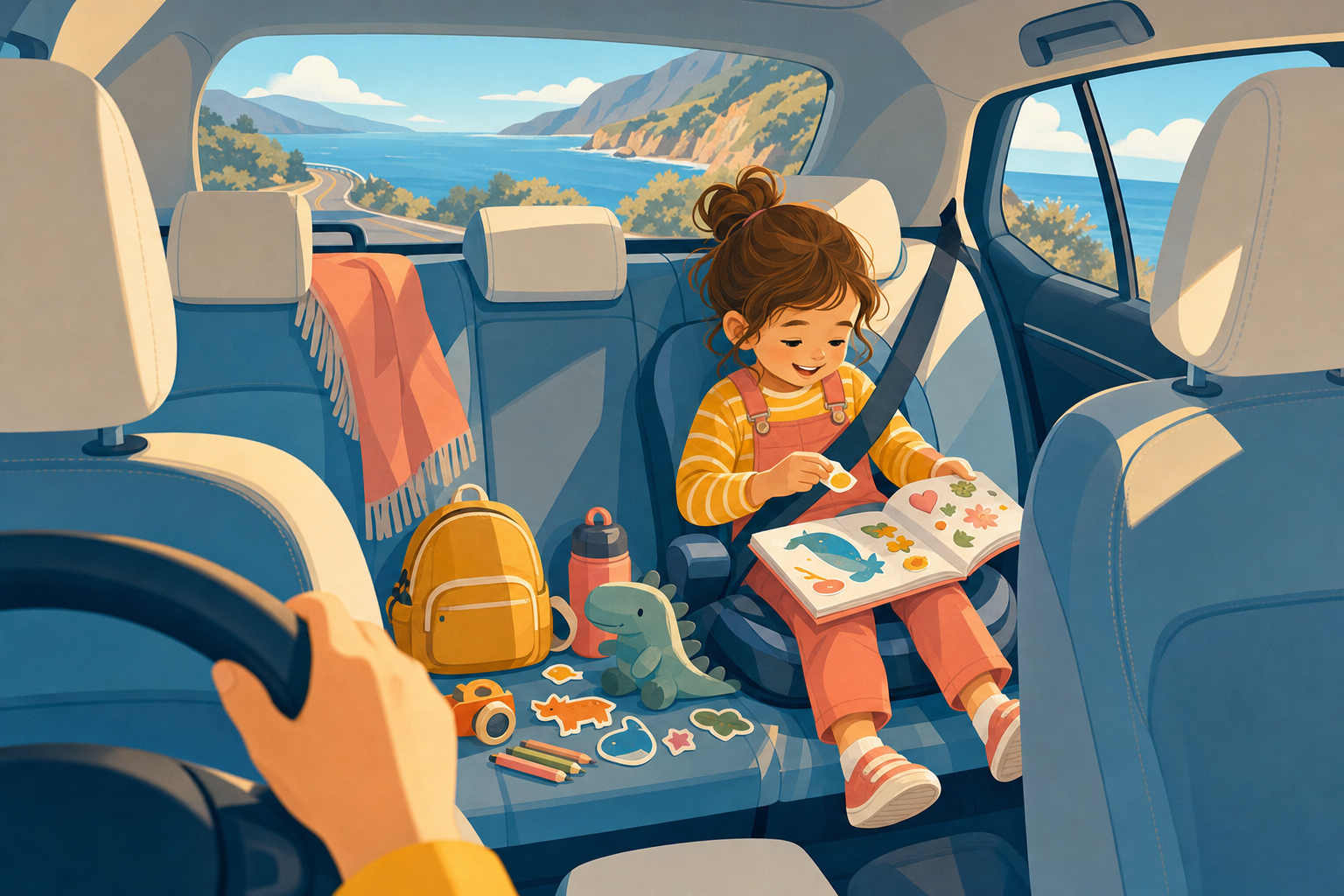
How to Keep a 2- to 6-Year-Old Busy on a Solo Parent Road Trip When You're Driving Alone and Need Screen-Free, One-Handed Activities
You're three hours from home, no co-parent in the passenger seat, and your preschooler just announced they're bored. You can't reach back to hand them a new toy. You can't pull over every twenty minutes. You need activities that work while you're actually driving, and they need to last longer than five minutes.
Solo parent road trips require a different playbook. The games and activities that work when two adults are in the car fall apart fast when you're alone behind the wheel. You need screen-free car activities for toddlers and preschoolers that don't require your hands, your eyes, or a roadside stop every half hour.
The Real Constraint: You Cannot Take Your Hands Off the Wheel
Most road trip activity lists assume someone can pass back supplies, reset a game, or fish a dropped toy from under the seat. When you're driving solo, none of that is possible. The activities that work are fully auditory, rely on what the child can already see, or use materials you preloaded within their reach before you left the driveway.
One-handed car games for kids are your foundation. These are games you can verbally set up, narrate, or reset without looking back. Think call-and-response songs, verbal scavenger hunts, and storytelling formats where your child does most of the talking.
Before you leave home, load a small bin or fabric tote in the seat next to your child with a rotating mix of solo-friendly items: a few board books, a water bottle with a sports cap, a snack cup with a lid, and one or two simple manipulatives like linking rings or a textured ball. Everything in that bin must be safe if thrown, dropped, or ignored. Nothing small enough to choke on, nothing that rolls under the seat and triggers a meltdown.
Audio Games That Work Without Props
Verbal travel activities for kids ages 2-6 are your strongest tool. Start with "I Spy" using only colors. ("I spy something blue." Your child guesses from what they can see out their window.) Keep it simple. Two-year-olds will guess the same thing five times in a row. That's fine. The goal is engagement, not variety.
Animal sound call-and-response works for younger toddlers. You say, "What does a cow say?" They answer. You confirm and move to the next animal. This can stretch for fifteen minutes if you cycle through barnyard animals, pets, zoo animals, and wildlife. For older preschoolers, flip it: "I'm thinking of an animal that says 'ribbit.' What is it?"
Storytelling games keep older preschoolers busy longer. Start a story and pause for your child to fill in a word. "Once upon a time, there was a... (child says 'dinosaur'). The dinosaur was looking for something to... (child says 'eat')." Let them steer the story. It doesn't have to make sense. The back-and-forth is what matters.
Singing works when nothing else does. Rotate between songs with hand motions they can do from a car seat ("Itsy Bitsy Spider," "Wheels on the Bus") and echo songs where they repeat each line after you. If you run out of kids' songs, sing pop songs, show tunes, or hymns. Familiarity matters more than genre.
If you need a list of truly no-prep travel games for kids that work in under two minutes, the post on no-prep car games for toddlers and preschoolers covers ten auditory and window-based options you can launch without pulling over.
Visual Scavenger Hunts Using the Window
Window-based solo parent road trip activities are your second line of defense. Call out objects for your child to spot: red cars, cows, stop signs, trucks, bridges. For a two-year-old, keep it to one object at a time. For a four- or five-year-old, give them a short list and let them shout when they see each one.
Color hunts work on any road. Pick a color and count how many things you both can spot in that color before you switch. This works in traffic, on highways, and in residential areas. It requires zero prep and resets instantly when your child loses interest.
Shape hunts are slightly harder but good for older preschoolers. "Find something circle. Find something rectangle." If they're developmentally ready, add "triangle" and "square." Point out examples as you go. ("That sign is a rectangle. That wheel is a circle.") They'll start recognizing shapes faster than you expect.
If your child is in the phase where they need something to hold while they play, preload a small dry-erase board or a clipboard with blank paper in the seat-back pocket. They can "check off" items during a scavenger hunt even if the marks are just scribbles. It gives their hands something to do while their brain stays engaged with the game.
Sensory and Manipulative Items That Work Solo
Easy car activities for long drives include a few well-chosen physical items your child can use independently. Linking rings, large pop-beads, or fabric activity books with buckles and zippers keep toddler hands busy without requiring your help. Choose items that are satisfying to manipulate, hard to lose, and safe if thrown.
A small photo album loaded with pictures of family, pets, or favorite places gives a two- or three-year-old something to look at and talk about. Laminated family photos work even better because they're indestructible. Your child can narrate who they see, what the person is doing, or where the photo was taken. You can prompt from the front seat without turning around.
Snack cups with lids and a few pieces of cereal or crackers double as an activity. A toddler will spend five to ten minutes fishing out individual pieces. A preschooler can count them, sort them by shape, or build a tiny pile on the seat beside them. Snacking is an activity when you're alone in the car and every minute counts.
A water bottle with a flip-top or sports cap is easier to manage solo than a sippy cup. Toddlers can open and close it independently, and it won't leak if they drop it. Hydration prevents crankiness, and the process of drinking gives them something to do with their hands and mouth when they're understimulated.
For a quiet, mess-light option mid-drive, printable coloring pages from Chunky Crayon can work if you pre-clip them to a lap board with jumbo crayons. That said, coloring requires more setup than most solo parent road trips allow, so save it for planned rest stops rather than active driving time.
Structuring the Drive in Phases
Road trip games for kids in one car seat row work best when you rotate activities every fifteen to twenty minutes. Start with an audio game. When your child gets wiggly, switch to a window scavenger hunt. When they stop looking out the window, move to a manipulative toy or snack break. When they're quiet, start a story or song.
You don't need a printed schedule. Just notice when engagement drops and pivot to a different sensory mode. Audio to visual. Visual to tactile. Tactile back to audio. The rotation keeps their brain from habituating to one input.
If your child is in the phase where boredom triggers big feelings, give them a few minutes of silence between activities. Not every moment needs to be filled. A four-year-old staring out the window and humming to themselves is not a crisis. It's processing time.
Plan one long stop halfway through your drive if the trip is over two hours. Let them run, climb, or jump for at least ten minutes. A rest-stop parking lot, a grassy area, or even laps around your parked car will reset their nervous system and buy you another hour of relative peace.
What to Say When They Ask for a Screen
Toddlers and preschoolers will ask for a tablet or phone if they know it's an option. If you've committed to screen-free car activities for toddlers and preschoolers, acknowledge the request without debating it. "We're not using screens right now. Let's find a red car together." Then redirect immediately into an activity.
If they escalate, stay calm and repeat your boundary. "I hear you. Screens are for later. Right now we're playing the animal game." Consistency matters more than perfect behavior. They'll test the boundary a few times, then move on.
Some parents keep a screen as a true emergency backup (illness, multi-hour delay, or meltdown that's unsafe while driving). If that's your plan, keep it in the trunk or glove box so it's not visible from the back seat. Out of sight reduces requests.
Sample Activity Rotation for a Two-Hour Solo Drive
Here's what a realistic two-hour solo parent road trip might look like with a four-year-old:
- 0 to 20 minutes: Singing and echo songs while they settle in
- 20 to 35 minutes: Color scavenger hunt (spot five blue things, then five red things)
- 35 to 50 minutes: Snack cup and water bottle while you narrate what you see out your window
- 50 to 65 minutes: "I Spy" using objects out their window
- 65 to 75 minutes: Rest stop (run, jump, stretch)
- 75 to 90 minutes: Story game where they fill in words
- 90 to 105 minutes: Linking rings or pop-beads from the pre-loaded bin
- 105 to 120 minutes: Animal sound game and final stretch of singing
Not every rotation will work. Sometimes they'll refuse the scavenger hunt and want to sing for forty minutes straight. That's fine. The structure is a framework, not a script.
What to Keep in the Car Permanently
If you're a solo parent who drives regularly, keep a small bin of backup supplies in the trunk: a few board books, a small blanket, an extra snack cup, a water bottle, and two or three simple toys that rotate in and out. Restock it after every trip so you're never starting from zero.
This bin is not the same as the activity bag you pack for a specific trip. It's your safety net for the unplanned errand that turns into a two-hour drive, the detour that adds an hour, or the day your child refuses to nap and you need to drive them around the block until they fall asleep.
The Last 30 Minutes Are the Hardest
No matter how well you plan, the last thirty minutes of a solo parent road trip are usually the hardest. Your child is done. You're tired. The activities that worked an hour ago are suddenly intolerable.
This is when you pull out your backup: a favorite song on repeat, a snack they don't usually get, or a simple counting game. ("Let's count to one hundred together. I'll start. One, two, three...") Counting is weirdly soothing for preschoolers and requires zero props.
If they're melting down and you're fifteen minutes from home, pull over. Let them cry for two minutes in a parking lot while you take three deep breaths. Then finish the drive. Sometimes stopping for sixty seconds is faster than white-knuckling the final stretch.
You Don't Need to Entertain Them the Entire Time
The goal of solo parent road trip activities is not to prevent every moment of boredom or fussiness. The goal is to have enough tools in your rotation that you can make it to your destination without anyone losing their mind.
Some drives will go smoothly. Some will be hard. On the hard ones, remind yourself that you made it. Your child is safe, you're safe, and next time you'll know which activities worked and which ones to skip. That's enough.