September 10, 2026
Toddler Airplane Travel Tray: Screen-Free Busy Ideas
Build a DIY travel tray for toddlers on flights with screen-free plane activities for kids ages 2 to 4. Get quiet, carry-on friendly ideas now.
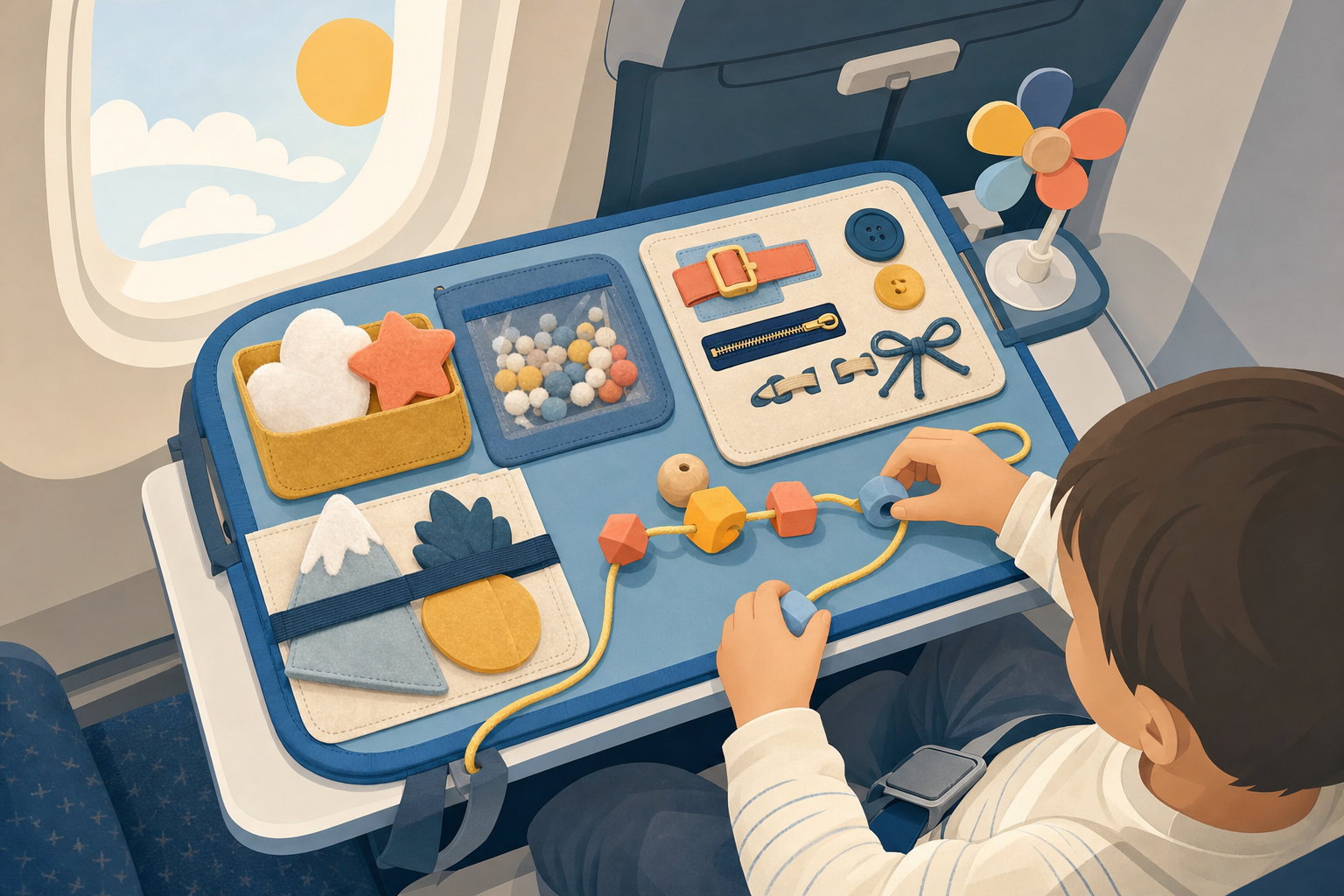
How to Build a Toddler Airplane Travel Tray That Actually Works (No Screens, No Coloring, No Giant Bag)
Your toddler is buckled into a seat with a tray table twelve inches from their face, no floor space to escape to, and a stranger's knee six inches from theirs. This is not a place for a backpack full of loose toys that roll under seat 14C the second you hit turbulence. You need one flat, contained setup that lives on the tray table and keeps a 2 to 4 year old busy without you unpacking half a suitcase.
Most "airplane busy bag" advice is written for a diaper bag, not a tray table. Here's how to actually build one that works in that tiny, upright, seatbelt-sign-on space.
Why the Tray Table Is the Whole Problem (and the Whole Solution)
A toddler's usable airplane real estate is roughly the size of a placemat. Anything that needs floor space, a table, or two free hands to set up is dead on arrival once the seatbelt sign is on or a flight attendant is squeezing past with the cart.
The fix is to design activities around that footprint from the start, not to pack toys and hope they fit. Think placemat-sized, one-hand-operable, and impossible to lose down the seat gap.
That means:
- No small loose pieces that bounce (dice, tiny figurines, puzzle pieces under an inch)
- Nothing that needs a hard surface bigger than the tray
- Nothing that needs two adults to manage
- Nothing with 40 pieces you have to count back into a bag at landing
A true travel tray for toddlers on flights is less "toy bag" and more "one flat kit that unfolds and refolds in seconds."
What Goes in the Kit (and Why Coloring Isn't the Star)
Coloring gets recommended constantly for airplane activities for toddlers, but at ages 2 to 4 it's a shaky pick: crayons roll, markers bleed through onto strangers' pants, and a 2 year old's attention span for coloring is often under five minutes. Save it as a backup, not the main event.
Instead, build the kit around these categories:
1. One reusable sticker or magnet board. A soft felt board with 15 to 20 foam stickers keeps little hands busy for 20+ minutes because the pieces reattach instead of getting used up. This is the single best screen-free plane activity for kids this age because it's quiet, mess-free, and self-correcting (nothing to "finish" or lose interest in).
2. A zippered pouch of textured objects. Three or four items with very different textures (a small pom-pom, a piece of velcro, a smooth stone, a bit of ribbon) turn into a simple guessing game: close eyes, feel one, guess what it is. No batteries, no noise, no mess.
3. A mini lacing card or button board. Threading a shoelace through holes punched in a laminated card is genuinely absorbing for a toddler and takes up almost no space. It also happens to be great fine motor practice for a squirmy kid stuck sitting still.
4. A small photo book of family faces. Print 8 to 10 photos of people and pets your toddler knows, hole punch a corner, and ring-bind them. "Where's Grandma? Where's the dog?" is a five minute game you can replay the whole flight.
5. One "mystery" snack pouch. Not for eating right away, for opening. A pouch with a snap or zip that takes a few tries to open gives toddlers a task and a reward built into one object.
That's it. Five items, all flat, all reusable, all fit inside one gallon-size zip pouch that lives in the seatback pocket, not the overhead bin.
Building the Tray Setup Step by Step
Here's the actual assembly, not just a list of ideas.
- Start with a base mat. A silicone placemat or a folded cloth about the size of the tray table gives every activity a defined "work surface" so pieces don't slide toward the aisle.
- Attach the felt board to the mat with a binder clip at one corner. This keeps it from sliding off the tray during turbulence or when the seat in front reclines into your toddler's lap.
- Load one activity at a time. Don't dump all five items on the tray at once. Toddlers get overwhelmed by choice. Hand over the felt board first, then swap when interest drops (usually every 8 to 15 minutes).
- Keep the swap system in the same pouch order every time. Front pocket: felt board. Middle: texture pouch and lacing card. Back: photo book and snack pouch. Muscle memory means you're not digging mid-flight while your toddler starts to unravel.
- Pack a small trash bag or extra zip pouch for "finished" pieces. Foam stickers that fall off, wrappers, anything loose gets swept into it instead of onto the floor.
This whole kit should weigh under a pound and fit in a gallon zip bag. That's the test: if it doesn't fit in one bag you can hold up with two fingers, it's too much for a tray table.
Timing It to the Flight, Not the Clock
A busy bag for airplane use only works if you sequence it to match the actual flight, not just "pack five things and hope."
- Boarding to takeoff (10 to 20 minutes): photo book. Low energy needed, easy to pause when the safety demo starts.
- Cruising, seatbelt sign off (bulk of the flight): felt board and lacing card, alternating every 10 to 15 minutes.
- Turbulence or seatbelt sign back on: texture pouch. It works one-handed, doesn't need the tray, and can be done in a lap.
- Descent (last 20 to 30 minutes, ears popping, mood dropping): snack pouch and, if you packed it, a small coloring booklet as a last resort. This is the one moment coloring earns its spot in the bag, because a low-key task at the very end helps offset the ear pressure discomfort.
If you also want a couple of low-key sensory options for the descent window, printable coloring pages from Chunky Crayon work well as that one exception since they need almost no supplies and pack completely flat.
Common Mistakes That Sink a Travel Tray Setup
Packing too many activities. More than five options and you spend the flight managing the bag instead of your toddler. Five is a ceiling, not a goal.
Choosing anything with small parts under an inch. If it can vanish under a seat or become a choking risk, leave it home.
Forgetting the swap system. A pile of toys dumped on a tray gets ignored in favor of the one novel item, then the whole tray gets pushed onto the floor. Rotate one at a time.
Assuming quiet travel activities for a 2 year old need to be new. Novelty matters less than you'd think at this age. A familiar felt board they've used at home actually works better on a plane because there's no learning curve mid-flight.
If you're building out plane essentials for toddlers beyond the tray itself, like snacks, a change of clothes, and a small stuffed comfort item, our guide to a general kids' travel activity bag covers the wider carry-on picture, and if the trip includes long stretches without a car seat option, screen-free hotel room activities can help once you land, since jet lag often means quiet awake time at odd hours.
The Bottom Line
A good toddler travel tray isn't a bigger bag, it's a smaller, smarter one. Five flat, reusable, one-handed activities in a single zip pouch, swapped one at a time and timed to match takeoff, cruising, and descent, will outlast almost any oversized carry-on stuffed with toys your toddler forgets after two minutes. Build it once before the trip, and you'll reuse the same kit on every flight until they age out of it.