June 4, 2026
Night Road Trip Activities: Keep Kids Entertained After Dark
Discover screen-free night road trip activities that keep 3 to 7 year olds calm and entertained in the dark. Quiet car games perfect for siblings and sleepy drives.
How to Keep a 3- to 7-Year-Old Entertained on a Road Trip at Night Without Screens, Meltdowns, or Waking Siblings
You're driving through the dark, trying to make time, and your 5-year-old just announced they're "not even tired" while your 3-year-old is finally asleep in the next seat. Welcome to the nighttime road trip, where every activity needs to be quiet enough not to wake siblings, calm enough not to trigger a second wind, and engaging enough to prevent a meltdown in the middle of nowhere.
Night road trip activities for kids require a completely different playbook than daytime games. You're not trying to burn energy or get loud laughs. You're trying to keep one kid gently occupied while protecting the peace for everyone else in the car. Here's how to make it work.
Set Up Your Car for Sleepy-Time Success Before You Leave
The best nighttime drive starts before you pull out of the driveway. If you're hoping kids will sleep, treat the car like a bedroom on wheels.
Put siblings in separate rows if possible. A 3-year-old who's out cold doesn't need a 6-year-old's whisper-singing two feet away. If you're in a sedan or smaller SUV, try a visual divider like a rolled hoodie between car seats or a small travel pillow wedged as a buffer.
Dim the cabin lights and cover any blinking electronics with black tape or a cloth. Even a charging cable light can keep a preschooler wired. Use a small clip-on book light for the parent in the passenger seat if you need to see, but keep it angled away from the back seats.
Pack a "night drive bag" that lives up front, separate from daytime toys. This signals to your kid that nighttime car activities are different, calmer, and not up for negotiation. Inside: a small stuffed animal, a soft book, a quiet fidget toy (think a fabric taggie or a squishy ball, not anything that clicks), and one or two audiobook options queued up on your phone.
Choose Low-Stimulation Audio That Holds Attention Without Ramping Energy
Audiobooks and story podcasts are your secret weapon for screen-free long drives after bedtime. A good story gives a wide-awake kid something to focus on while siblings sleep, and it doesn't require light, mess, or movement.
Pick stories that are engaging but not action-packed. Skip the books with sudden sound effects or high-stakes chases. Instead, go for gentle chapter books (Magic Tree House, Ivy and Bean, Junie B. Jones for older kids; Frog and Toad or Little Bear for younger ones) or calming story podcasts like Story Pirates or Circle Round.
Keep the volume low and use a single earbud for the awake child if you can. Wired earbuds (not Bluetooth) are more reliable for a long drive, and you can thread the cord through their seatbelt so it doesn't tangle. If earbuds won't stay in or aren't safe for your kid's age, play audio softly through the car speakers and accept that the driver will be listening to Frog and Toad for three hours.
Rotate stories every 30 to 45 minutes. Even a kid who loves a book will tune out after too long, and that's when the "I'm bored" whining starts. Have a backup playlist of calm instrumental music (lo-fi beats, classical, or movie soundtracks) for when stories lose their magic.
Play Quiet Car Games for Siblings That Don't Require Talking or Light
Some kids won't sleep no matter how dark or boring you make the car. That's when you need road trip games in the dark that keep hands and minds busy without waking anyone up.
Start with silent counting games. "Count how many streetlights you see in the next five minutes" or "Count every red car that passes us." Write the number on a small whiteboard or let them track it on their fingers. It's low-effort for you and surprisingly absorbing for a preschooler.
Try a quiet "I Spy" with textures instead of colors. "I spy something soft" (their blanket). "I spy something cold" (the window). This version works in the dark and doesn't require shouting guesses back and forth. For more no-prep ideas that translate well to nighttime, check out these no equipment car games that keep kids engaged without supplies.
Use a small, dim book light and a travel-size Etch A Sketch or magnetic drawing board. These are quiet, self-contained, and don't require you to dig out crayons or worry about dropped pieces. Printable coloring pages from Chunky Crayon are another mess-free option if your kid can handle a clipboard and a single crayon in low light.
Avoid anything with small pieces, anything that makes noise, or anything that requires the overhead light. A dropped toy at 10 p.m. is a five-minute excavation mission that wakes everyone.
Build in Calm-Down Moments Before Meltdowns Start
Even the best car activities for kids at night will eventually wear thin. A 5-year-old who's been awake for two hours past bedtime is going to get cranky, and you need to catch it early.
Watch for the warning signs: squirming, whining about being "too hot," asking how much longer every three minutes. When you see them, pull over at a rest stop or gas station for a five-minute reset. Let your kid walk circles around the car, stretch, get a drink of water. Do not let them run laps or climb on anything. The goal is to release tension without spiking energy.
If pulling over isn't an option, try a two-minute breathing game. "Let's see if we can take five super-slow breaths together." Model it yourself and count out loud. It sounds too simple to work, but it genuinely helps a wired preschooler regulate.
Keep a small surprise in your night drive bag for emergencies. A new-to-them small toy (a $1 animal figurine, a squishy, a glow stick) or a special snack they don't usually get (a juice box, a single cookie) can buy you another 30 minutes of peace. Use it strategically, not as a first resort.
Know When to Let Them Stare Out the Window and Be Bored
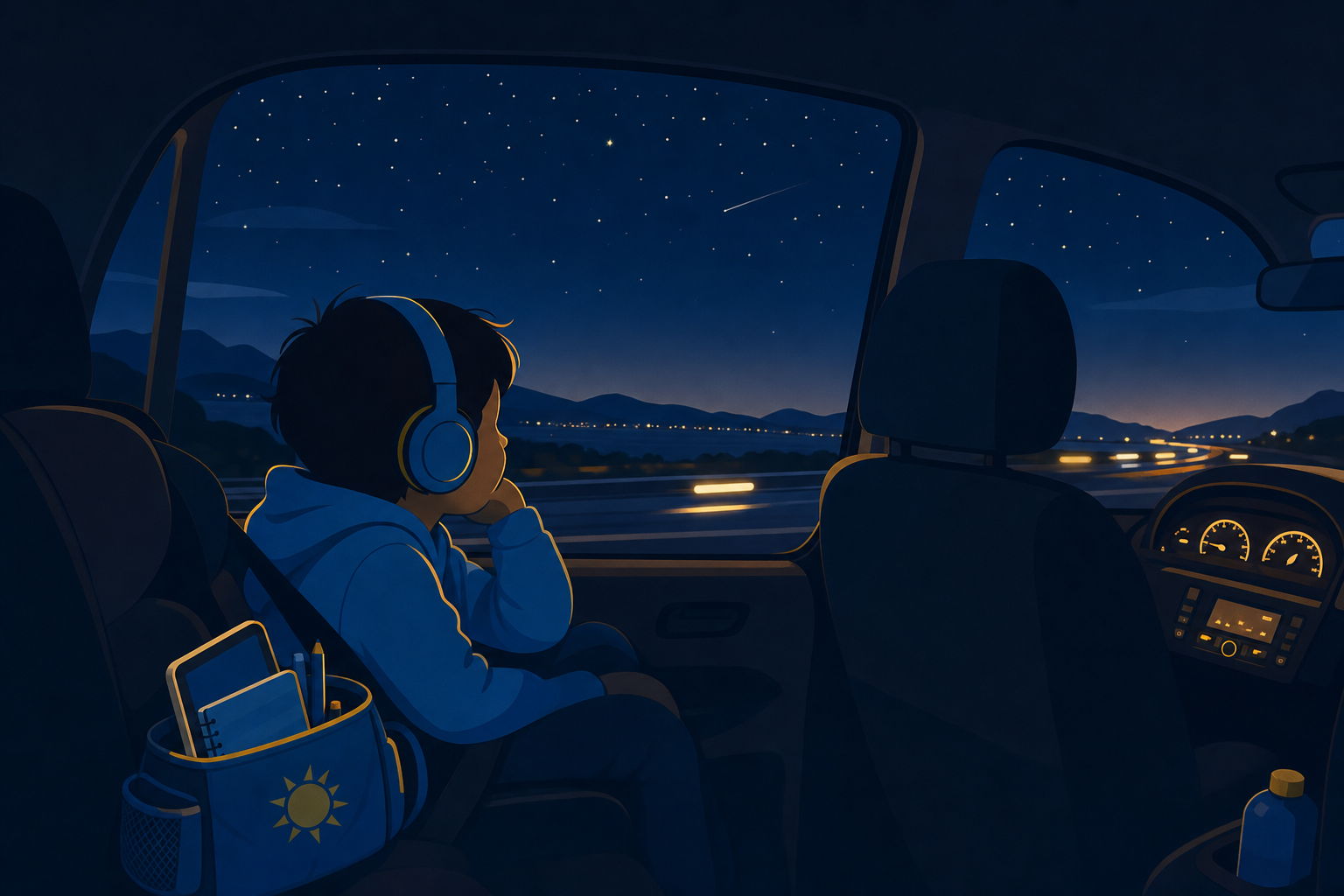
Sometimes the best travel activities for preschoolers at night are no activities at all. If your kid is quietly looking out the window, not crying, not waking siblings, let them be.
Boredom is not an emergency. A 6-year-old who's gazing at the dark highway might be processing the day, might be drifting toward sleep, or might just be okay with the quiet. You don't need to fill every moment with entertainment, especially at night when calm is the goal. For more on why this kind of downtime matters, see what to do when your kid says 'I'm bored' (spoiler: sometimes the answer is nothing).
If they start to escalate, step in. But if they're just existing in the dark, that's a win.
Pack a Nighttime-Specific Routine into Your Trip
If you're planning a longer drive and want everyone to sleep, layer in pieces of your regular bedtime routine. Brush teeth before you leave (or at the first rest stop), change into pajamas in the car or at home, bring the same stuffed animal or blanket they sleep with every night.
Consistency cues the body that it's time to wind down, even when you're on the highway. If your usual routine includes a song or a short story, do a car-friendly version. One parent can sit in the back seat for the first 20 minutes to help settle a resistant sleeper, then move to the front once they're out.
If you're working on building reliable routines at home, a travel routine for kids can help you figure out what to keep and what to skip when you're on the road.
What Worked for One Kid Might Not Work for the Other
Your 7-year-old might love audiobooks and drift off after two chapters. Your 4-year-old might find them boring and need a quiet fidget toy and a whispered counting game instead. That's normal.
Don't force the same strategy on every kid. Pack options, stay flexible, and remember that the goal isn't perfection. The goal is making it to your destination without anyone losing it in the back seat.
Night drives are hard. You're tired, the kids are off-schedule, and the stakes feel high when you just need everyone to stay calm. But with the right setup, a few low-key activities, and realistic expectations, you can keep a 3- to 7-year-old entertained (or at least not melting down) while siblings sleep and you make miles in the dark.