May 18, 2026
Road Trip Activities for 3-6 Year Olds (No Screens Needed)
Keep preschoolers happy on long drives with these screen-free car games and activities. Perfect for restless, carsick, or bored kids. Get our tested tips now.
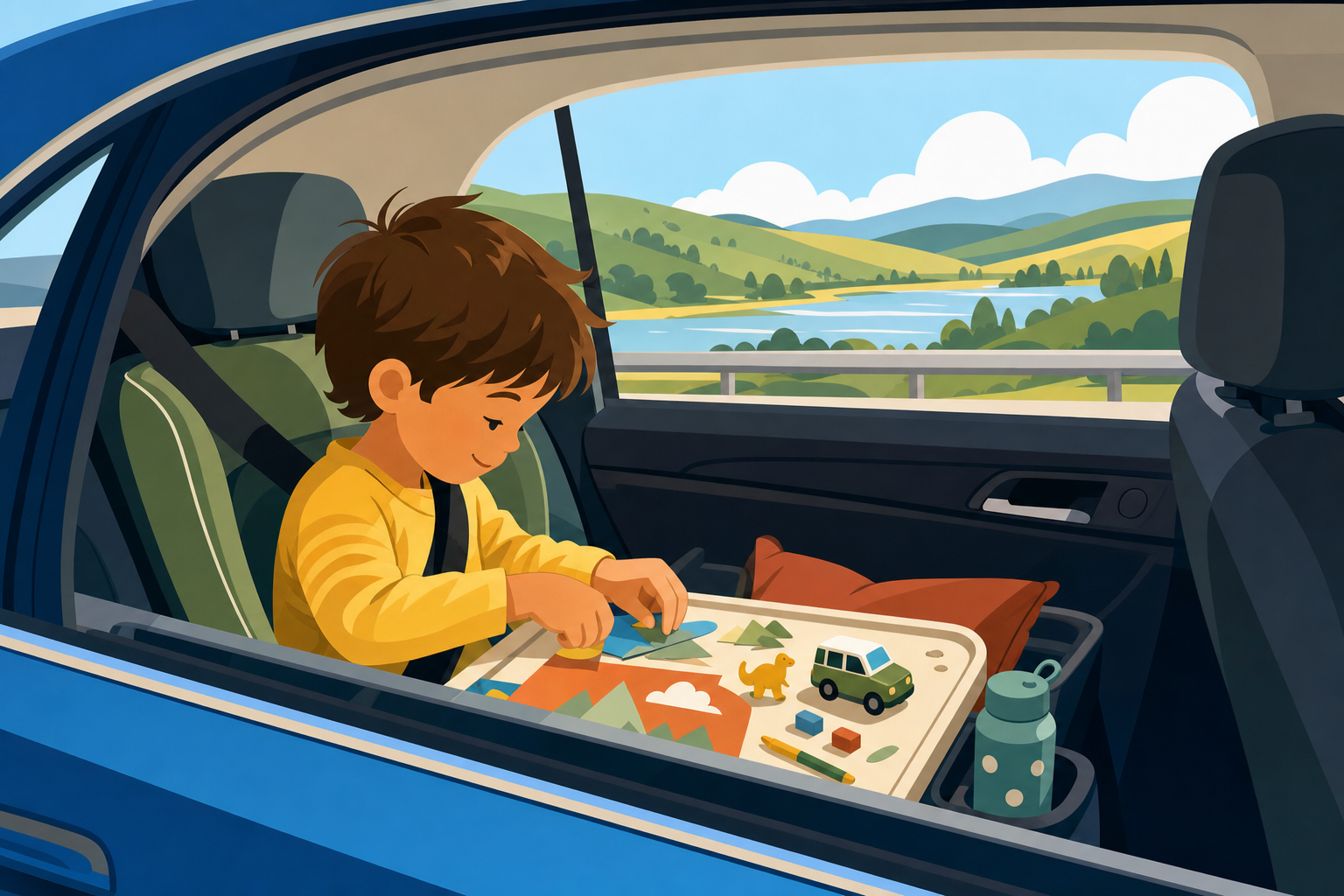
How to Keep a 3- to 6-Year-Old Busy on a Road Trip When They Get Carsick, Restless, or Bored After 20 Minutes
You're 40 minutes into a three-hour drive and your preschooler is already squirming, whining, or turning green. Screen time makes them queasy. Coloring makes them queasy. Looking down at anything makes them queasy. And even if nausea isn't the issue, their attention span evaporates faster than your coffee.
Most road trip activity lists don't help here. They assume your child can handle a tablet, a busy book, or sustained focus on one thing for 30 minutes. But when you're dealing with a carsick or fidgety 3- to 6-year-old, you need a different toolkit: activities that work in short bursts, don't require looking down, and keep little hands (and mouths) busy without making anyone barf.
Here's what actually works.
Why Standard Road Trip Activities Fail for Carsick or Restless Kids
Car sickness in young kids is triggered by a mismatch between what their eyes see (a stationary seat) and what their inner ear feels (motion). Looking down at a book, screen, or activity tray makes it worse.
Restlessness is different but equally disruptive. A 3-year-old's attention span tops out around 6 to 8 minutes per task. A 5-year-old might stretch to 10 or 15 minutes if they're deeply engaged. Expecting them to color quietly for an hour is like expecting you to enjoy a podcast on quantum physics while someone kicks your seat.
You need activities that cycle quickly, involve looking out the window or straight ahead, and require minimal setup from the driver's seat.
Road Trip Activities for 3 Year Olds (and Up) That Work When Looking Down Isn't an Option
Window scavenger hunts
Print or call out a simple list: red car, cow, stop sign, big truck, someone wearing a hat. Keep items broad and easy to spot. Your child looks out, not down.
If your 3-year-old can't read yet, use picture cues or just verbally prompt them every few minutes. "Can you find a yellow car? What about a tree?" This works for 10 to 15 minutes at a stretch, then swap to something else.
Verbal games that don't need props
These are lifesavers for car games for preschoolers because nothing gets dropped, nothing needs to be picked up, and no one has to look at anything.
- I Spy (with modifications): Use colors and shapes only. "I spy something green." Keep it to things inside the car or very obviously outside the window.
- Rhyme time: You say a word ("cat"), they say a rhyme ("bat, hat, mat"). It doesn't have to be perfect. Silly words count.
- Animal sounds: You name an animal, they make the sound. Then reverse it.
- Counting game: Count red cars, yellow lines, exits, or cows. Stop at 10 and start over with a new category.
These work in 5- to 10-minute bursts. Rotate through them.
Sing-along songs with hand motions
Songs with gestures ("Wheels on the Bus," "Head, Shoulders, Knees and Toes," "If You're Happy and You Know It") give kids something physical to do without looking down. The motion helps with restlessness and doesn't worsen nausea because they're not focused on a static object.
Keep a playlist queued or just repeat the same five songs. Preschoolers love repetition. You'll lose your mind, but they'll stay happier.
Snack time as an activity
Not just snacks for fuel, but snacks as entertainment. Pack individual cups or bags with a mix (Cheerios, raisins, goldfish crackers, mini pretzels). Let them sort by type, count pieces, or build tiny towers on their lap tray before eating.
Crunchy, non-sugary snacks also help some kids with mild nausea. Avoid anything sweet, dairy-heavy, or greasy if car sickness is in play.
Screen-Free Road Trip Ideas That Work for Short Attention Spans
If you've already covered screen-free car activities for toddlers on long road trips, you know the basics. But for a kid who gets bored after 20 minutes, the key is rotation and low stakes.
Sticker scenes (not sticker books)
Sticker books require looking down and fine motor precision. Instead, give your child a plain file folder or piece of cardstock and a sheet of large, repositionable stickers. They can stick and re-stick without a "correct" outcome. This works for 10 to 15 minutes if they're not feeling queasy.
If nausea is the issue, skip this entirely.
Felt boards or magnetic dolls
These sit upright on a lap tray or the back of the seat in front of them. Kids can dress a felt doll, arrange shapes, or build scenes without looking straight down. The tactile element keeps hands busy.
Keep the pieces large and minimal. Five pieces max, or you'll spend the rest of the drive fishing them out from under seats.
Audio stories and kid podcasts
Not the same as screen time. Audiobooks and story podcasts let kids look out the window or close their eyes while staying engaged. Try "Circle Round," "Wow in the World," or any picture book your child loves, played as an audiobook.
Some kids zone out after 10 minutes. Others will listen for 30. Test a few at home before the trip.
Printable coloring pages (for pit stops or non-queasy moments)
If your child isn't currently feeling sick and you're at a rest stop or parked, coloring works well in short doses. Printable coloring pages from Chunky Crayon are a quiet, mess-light car activity for those moments when looking down won't trigger nausea. Just don't hand them over mid-drive if your kid is prone to car sickness.
Carsick Kid Road Trip Tips: What to Do When Nausea Hits
If your child is actively queasy, most activities stop working. Here's what helps:
Get their eyes on the horizon
Have them look out the front windshield, not side windows. The forward view stabilizes their sense of motion. Crack a window for fresh air.
Stop all activities that require looking down
No books, no coloring, no lap trays. Even verbal games can wait if they're feeling green.
Offer plain crackers or pretzels
A little bit of bland food can settle the stomach. Keep a small baggie within reach.
Pull over if needed
Seriously. Ten minutes parked at a rest stop, letting them walk around and reset, is faster than cleaning vomit out of a car seat. Don't push through.
Use a comfort item
A small stuffed animal, a favorite blanket, or a quiet toy they can hold without looking at. Sometimes just clutching something familiar helps.
Long Car Ride Activities for Preschoolers: How to Rotate and Keep It Fresh
The mistake most parents make is handing over all the activities at once. Your kid will blow through everything in the first hour and have nothing left.
Instead, ration.
Pack activities in numbered bags or bins
Label them "Bag 1," "Bag 2," etc. Give one every 30 to 45 minutes. Each bag has one or two small items: a new pack of stickers, a small toy, a snack cup, a travel game.
The novelty of opening a new bag buys you 10 minutes of goodwill, even before they see what's inside.
Alternate active and quiet
Follow a loud, wiggly activity (songs with motions) with a calm one (audiobook or looking out the window). If your child just did something hands-on (stickers or felt board), switch to something verbal (I Spy or rhyming).
Build in frequent stops
Every 60 to 90 minutes, pull over. Let them run, jump, climb, or just stand outside the car for five minutes. Physical movement resets restlessness better than any toy.
If your kid tends to get bored and antsy even at home, they'll need these breaks even more on the road.
What to Do With a Bored Toddler in the Car When Nothing Is Working
Sometimes, despite your best planning, your child will still melt down. Here's the reality: you can't entertain them every second for four hours. And that's okay.
Let them be bored for a few minutes
Boredom isn't an emergency. If they've cycled through activities and nothing is landing, give them space to just sit. Some kids will stare out the window, hum to themselves, or fall asleep. Others will whine, but they'll survive.
Narrate the drive
Talk about what you see. "Look, a blue truck. I wonder where it's going. Oh, there's a big tree. Do you think birds live in it?" Your voice is soothing, and it models how to find interest in the world without needing constant stimulation.
Accept that some trips will just be hard
You're not failing if your 3-year-old cries for 20 minutes. You're not a bad parent if you have to listen to "Baby Shark" 47 times. Sometimes survival mode is the win.
One Last Thing: Prep Your Kit Before You Leave
Gather travel activities for young kids the night before. Pack them in order. Have a trash bag, wet wipes, and a change of clothes within arm's reach. Test audio equipment and download offline content.
The more you prep, the less you'll need to problem-solve while driving 70 mph with a whining preschooler behind you.
And if you need a full printable activity pack tailored to your kid's age and trip length, Kids Road Kit generates one in about two minutes. No sign-up, no upsell. Just print and go.