August 16, 2026
Screen-Free Airport Activity Pack for Kids Ages 3 to 6
Build a screen-free airport activity pack with quiet plane activities, printable travel kits, and a scavenger hunt kids ages 3 to 5 will love. Get the free printables.
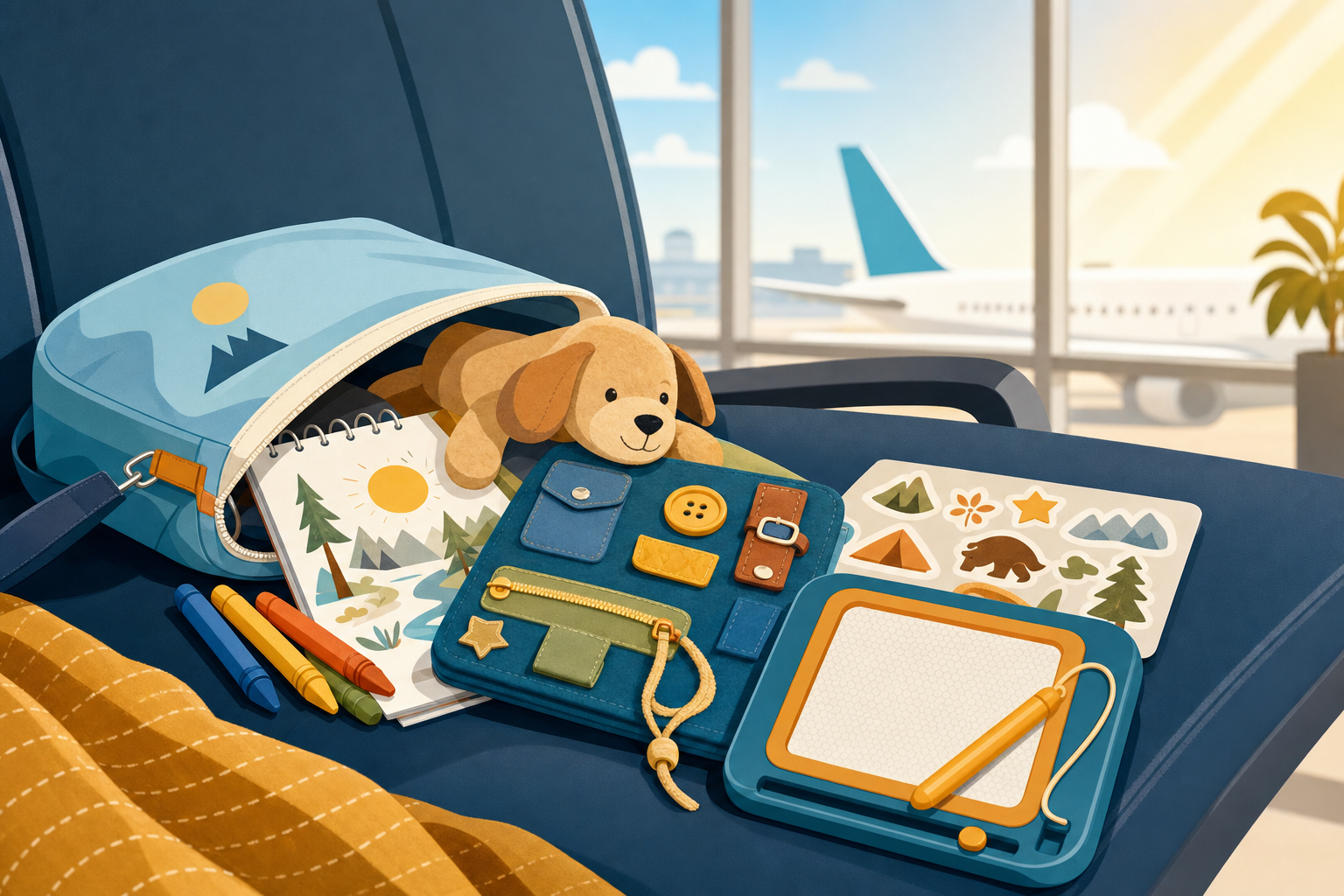
How to Build a Screen-Free Airport Activity Pack for a 3- to 6-Year-Old That Actually Works From Check-In to Takeoff
You're standing in a security line with a squirmy preschooler, a rolling suitcase, and a tablet you swore you wouldn't rely on. Then the battery dies at gate B12. This is the moment most airport activity packs fail parents: they're built for a kid sitting still at a table, not one bouncing between check-in, security, a gate change, and a middle seat.
The fix isn't more stuff. It's the right stuff, in the right order, pulled out at the right moments. Here's how to build a pack that actually survives real airport chaos.
Why Most Airport Activity Packs Fail
Most printable travel kits assume a calm, seated kid with a tray table and 20 minutes of focus. Real airport travel with a 3- to 6-year-old looks more like: 10 minutes of walking, 15 minutes of standing in line, a sudden need to pee, then a burst of boredom right as boarding is delayed.
Generic worksheet bundles also skew too school-like. A worksheet with instructions like "circle the odd one out" is a hard sell when your kid is overtired and overstimulated by fluorescent lights and announcements. What works instead is short, physical, low-mess activities that flex with unpredictable waiting.
The goal isn't to entertain for six straight hours. It's to have five or six short activities that each buy you 10 to 15 minutes, stacked back to back.
What Goes in the Pack (and What to Leave Home)
Keep the whole kit in a gallon zip bag or a small pencil case that fits in the seat pocket. For this age group, less is more; too many loose pieces means more things to drop, lose, or cry about.
Pack these:
- A small clipboard or hard book (for a writing surface without a tray table)
- Mini dry-erase board with one marker (endless tic-tac-toe, hangman, doodles)
- A pack of stickers and a small notebook for a "sticker story"
- Pipe cleaners (bendable, quiet, great for shapes and finger rings)
- A printable airport scavenger hunt sheet (see below)
- One small mystery item (a fidget, a tiny toy) wrapped in paper to "unwrap" mid-flight
- A few printable coloring pages, folded flat
Skip these:
- Loose crayon boxes (they spill; bring 2 to 3 crayons in a snack bag instead)
- Anything with small pieces that roll (dice, tiny figurines)
- Books that are too long to finish in one sitting; short ones or a favorite reread work better
- Snacks that crumble everywhere (save those for the seat, not the security line)
If you want a done-for-you version of this exact setup, our free airport activity pack generator builds a printable kit sized to your child's age and flight length, no email required.
The Airport Scavenger Hunt: Your Check-In-to-Gate Secret Weapon
The walk from check-in to the gate is often 20 to 40 minutes of dead time, and it's the easiest part of the trip to fill without any supplies at all. An airport scavenger hunt turns hallway boredom into a mission.
Before you go, print (or hand-write) a simple list your child can check off:
- A dog (service animal or a fellow traveler's pet)
- Something red
- A plane out the window
- A worker in a uniform
- A suitcase with wheels that light up or spin
- A clock
- Someone wearing a hat
Keep it to 6 to 8 items max for this age. Let your child hold the list and a pencil, or just call things out if writing while walking is too much. This single sheet can stretch from check-in through the security line and all the way to the gate.
Quiet Activities for the Actual Flight (Seatbelt Sign On)
Once you're buckled in, the game changes. You need things that work in a cramped space, don't roll away, and don't need a full arm swing.
Try these, in this order:
- Dry-erase tic-tac-toe or dot-to-dot. Wipeable, silent, endlessly repeatable.
- Sticker story. Give a small notebook and stickers; your child places stickers on a page and tells you a one-line story about each one.
- Pipe cleaner shapes. Ask for a circle, a letter, a snake, a tiny crown. Bendable and quiet even at 3am on a red-eye.
- The mystery item unwrap. Wrap a small toy or fidget in a few layers of paper ahead of time. Unwrapping alone can take 10 minutes and feels like a present.
- Whisper I Spy. No supplies needed, just quiet voices, using the seatback, window, or other passengers' bags as targets.
Rotate through these rather than dumping the whole bag out at once. Pulling one thing out every 15 to 20 minutes keeps the pack feeling fresh instead of overwhelming.
For a longer stretch of downtime, like a layover or a delay at the gate, the same rotation approach works well; we cover more of that ground in our guide to keeping a young child entertained on a layover with almost no supplies.
Timing It Right: A Simple Stage-by-Stage Plan
Think of the trip in four stages, and match the activity to the stage instead of trying to use everything everywhere.
- Check-in to security: Scavenger hunt list, verbal I Spy
- Security to gate: Continue scavenger hunt, add "count the planes out the window"
- Waiting at the gate: Dry-erase board, pipe cleaners, sticker notebook
- On the plane, taxi to cruising altitude: Mystery item unwrap, quiet coloring, a short reread of a favorite book
If your flight includes a layover, save one or two activities completely untouched for that stretch instead of using everything on the first leg. A fresh activity beats a repeated one every time.
Printable coloring pages from Chunky Crayon are worth adding to the mix too. They're a quiet, mess-light option for the moments when your child just wants to sit and color without needing new instructions from you.
A Few Extra Tips That Save Meltdowns
- Let your child carry their own small pack or pouch. Ownership makes them more invested in using it.
- Introduce one new item per trip, not the whole kit at once, so nothing feels overwhelming or overly novel all at once.
- Bring a small trash bag for wrappers and used paper; airport seating areas rarely have enough bins nearby.
- If your child struggles with new environments or transitions in general, a simple visual cue, like a small picture card showing "security, then gate, then plane," can ease anxiety the same way visual routine charts help with other overwhelming transitions.
If this trip is just one leg of a longer journey, and you'll be back in a car seat before or after the flight, our guide to packing a screen-free toddler road trip kit covers the car-specific version of this same approach.
The Bottom Line
You don't need a giant binder of worksheets to get through an airport with a 3- to 6-year-old. You need six or seven small, quiet, low-mess activities, a scavenger hunt for the walking parts, and a plan for when to pull each one out. Pack light, rotate often, and save something fresh for the parts of the trip that always run longer than expected.