July 17, 2026
Road Trip Activities for Kids Who Can't Read (Ages 2 to 5)
Discover 15+ screen-free car games perfect for preschoolers who can't read yet. Keep toddlers engaged on long drives with these proven, no-reading activities.
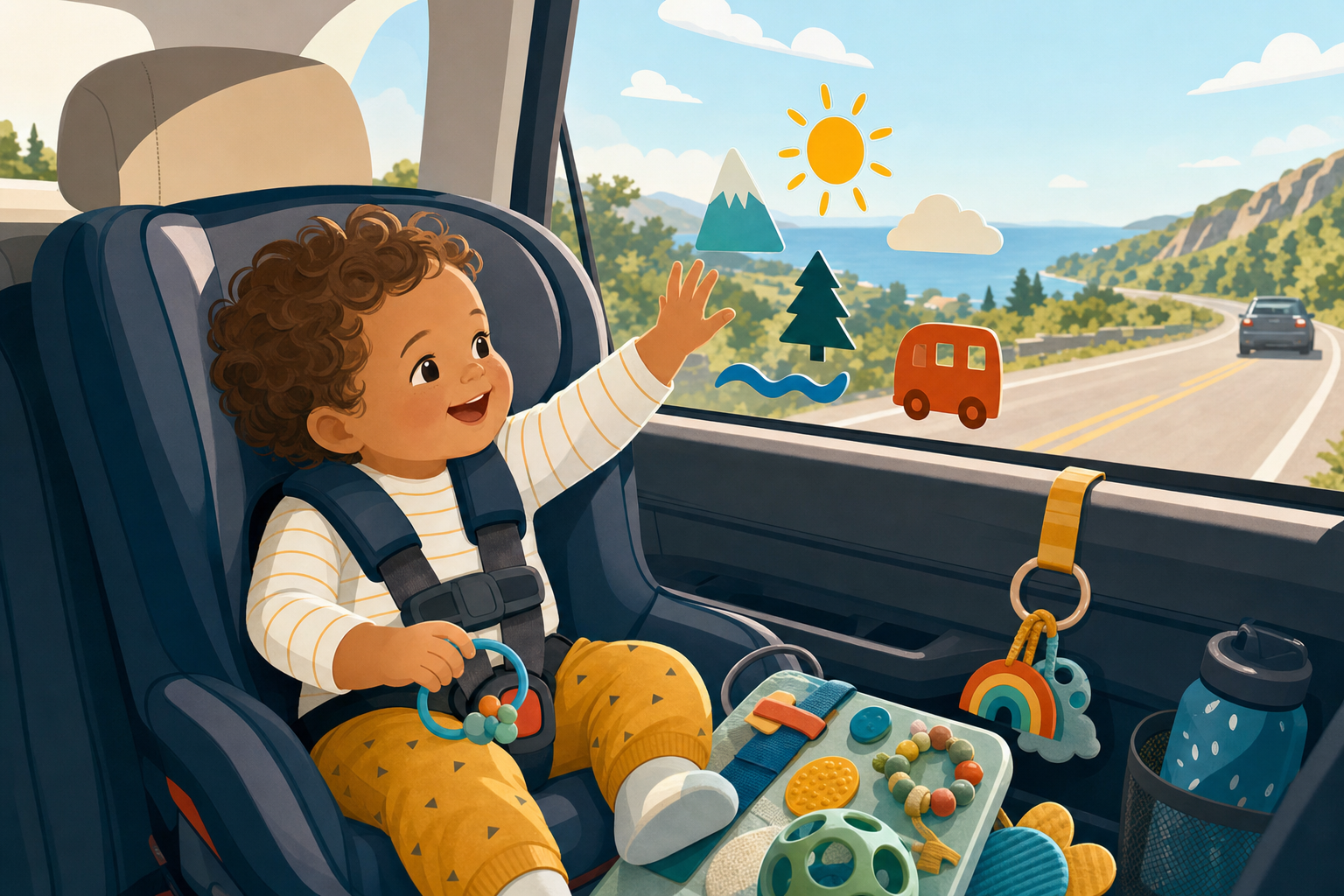
Screen-Free Road Trip Activities Specifically for Non-Readers (Ages 2 to 5): A Step-by-Step Guide to Text-Free Car Games
Your toddler can't read yet, and every road trip activity you find online involves circling pictures, matching letters, or following written instructions they don't understand. You're 45 minutes into a three-hour drive, the tablet is off-limits, and you need something that actually works for a preschooler who can't decode a single word.
This guide walks through specific road trip activities for kids who can't read, with zero reliance on text, worksheets, or anything requiring literacy skills. These are tested, concrete car games for preschoolers who can't read, organized by how much prep they need and how long they'll hold attention.
Why Most Road Trip Activities Fail for Non-Readers
Most printable car games assume kids can read instructions, circle words, or identify letters. A scavenger hunt that says "Find a red car" only works if your 3-year-old can read "red car." Even "simple" I Spy games often use clues like "something that starts with B," which means nothing to a child who doesn't know letter sounds yet.
Travel activities for kids ages 2 to 5 who can't read need to rely entirely on what they can see, hear, touch, or repeat back to you. No written clues. No worksheets with instructions. Just verbal cues, visual matching, and tactile play.
For kids who get carsick and can't focus on objects outside the window, check out our guide to road trip games for kids who get carsick, which includes activities that don't require looking out at all.
Color and Shape I Spy (Zero Prep, Works Immediately)
Regular I Spy asks kids to guess a specific object. For non-readers, flip it: you describe only the color or shape, and they point to anything that matches.
How to play:
- Say, "I spy something blue." Your child points to anything blue they can see: the sky, a car, their sippy cup, your shirt.
- They're right every time, because you didn't name a specific object.
- Take turns. Let them say, "I spy something circle," and you point to a wheel, a button, the sun.
Why it works: No wrong answers. No reading. No frustration. It builds color and shape vocabulary without requiring them to guess your exact thought.
Duration: 10 to 15 minutes per round. Restart whenever attention drifts.
Verbal Pattern Games (Call and Response, No Materials)
These no-reading road trip games for toddlers rely entirely on listening and repeating. No prep, no supplies, no visual focus required.
Clap-Tap-Stomp: You create a simple rhythm (clap, clap, tap knees). Your child repeats it. Add one more sound (clap, clap, tap, stomp). They repeat again. Keep adding until they can't keep up, then start over.
Animal Sound Chain: You say, "The cow says moo." Your child repeats it. Then you add, "The cow says moo, the dog says woof." They repeat both. Keep adding animals until the chain breaks.
Opposite Game: You say a word (hot, big, fast). They say the opposite (cold, small, slow). Start with easy pairs they know, then get sillier (loud, clean, awake).
Why it works: These screen-free car games for non-readers use only verbal skills, so kids who can't read or write can still participate fully. No looking required, which helps if your child gets carsick or the sun is too bright.
Duration: 5 to 10 minutes per game. Easy to restart when boredom hits.
Tactile Guessing Game (Small Bag of Textured Items)
This requires about five minutes of prep before you leave, but it's one of the longest-lasting road trip activities for kids who can't read.
What you need: A small drawstring bag or pillowcase. Fill it with 5 to 8 small items with different textures: a crayon, a toy car, a block, a plastic spoon, a small stuffed animal, a bouncy ball, a sock.
How to play:
- Your child reaches into the bag without looking.
- They feel one object and guess what it is before pulling it out.
- If they guess right, they keep it on their lap. If not, it goes back in.
- Once all items are out, refill the bag and start again.
Why it works: It's entirely tactile. No reading, no looking out the window, no instructions to follow. Just touch and guess. For more ideas that rely on touch rather than vision, see our post on road trip games for kids who get carsick.
Duration: 15 to 25 minutes if you refill the bag a few times.
Verbal Scavenger Hunt (You Narrate, They Point)
Most scavenger hunts require kids to read a list or circle pictures. This version uses only your voice and their pointing.
How to play:
- Say, "Point to something red." Your child points out the window or inside the car.
- Say, "Point to something with wheels." They point to a truck, a motorcycle, a bike rack.
- Say, "Point to something fluffy." They point to a cloud, a dog in another car, their stuffed animal.
Why it works: You control the clues verbally, so there's no reading required. You can adjust difficulty on the fly. If your child is struggling, make clues easier ("something yellow"). If they're bored, make clues harder ("something shiny and moving").
Duration: 10 to 20 minutes. Easy to pause and restart.
Sticker Sorting on a Folder (Minimal Mess, Maximum Focus)
This is the only activity on this list that requires a quick stop at a dollar store, but it's worth it for kids who need something to do with their hands.
What you need: A plain folder or piece of cardstock. A sheet of reusable puffy stickers (animals, shapes, cars, anything with variety).
How to play:
- Give your child the folder and the sticker sheet.
- Say, "Put all the animals on this side, all the cars on that side."
- Once sorted, peel them off and re-sort by color, size, or any other category you name.
Why it works: No reading. Just sorting and sticking. It's quiet, low-mess, and doesn't require looking out the window. If your child finishes and still needs more activities, printable coloring pages from Chunky Crayon are another mess-light option that works in the car.
Duration: 20 to 30 minutes if you keep changing the sorting rules.
For more hands-on ideas that work for preschoolers who need to stay busy with minimal mess, check out our list of no-mess sibling activities for ages 2 to 5.
Counting Game (Windows, Wheels, Animals)
This is a verbal counting game that doesn't require number recognition or writing. You just count out loud together.
How to play:
- Pick a category: red cars, motorcycles, cows, bridges, stop signs.
- Every time you see one, both of you say the next number out loud: "One!" "Two!" "Three!"
- Keep counting until you reach 10 or 20, then pick a new category and start over.
Why it works: No reading. No writing. Just counting out loud, which builds number sense without requiring kids to recognize written numerals.
Duration: 5 to 15 minutes per category. Easy to restart with a new category.
Singing Games (Call-Back Songs and Fill-in-the-Blank)
These screen-free car games for non-readers use songs your child already knows, with a twist that keeps them engaged.
Fill-in-the-Blank: Sing a familiar song (Wheels on the Bus, Old MacDonald, Twinkle Twinkle), but stop before the last word of each line. Your child fills it in. "Twinkle twinkle little (pause)." They shout, "Star!"
Substitute Words: Sing Wheels on the Bus, but replace "bus" with "train" or "plane." Let your child pick the vehicle. Sing it through with all new words.
Why it works: No reading. No looking. Just listening and responding. It works even when your child is tired or grumpy, because they already know the songs.
Duration: 5 to 10 minutes per song. Restart with a new song whenever attention drifts.
How to String These Together on a Long Drive
These road trip activities for kids who can't read work best when you rotate them every 15 to 20 minutes. Here's a sample two-hour rotation:
- 0 to 15 minutes: Color and Shape I Spy
- 15 to 30 minutes: Tactile Guessing Game
- 30 to 45 minutes: Verbal Scavenger Hunt
- 45 to 60 minutes: Sticker Sorting
- 60 to 75 minutes: Counting Game
- 75 to 90 minutes: Singing Games
- 90 to 105 minutes: Verbal Pattern Games
- 105 to 120 minutes: Restart with I Spy or Tactile Guessing
If your drive includes overnight stops and you need activities that work in both the car and hotel, see our guide to screen-free activities for long car rides with overnight stops.
What to Do When Nothing Works
Some kids won't engage with any car game when they're tired, hungry, or overstimulated. If your child shuts down every activity, try these instead:
- Stop talking. Let them stare out the window in silence for 10 minutes.
- Offer a snack, even if it's not snack time.
- Play instrumental music (no words) and let them zone out.
- Pull over for a 5-minute stretch break, even if you're not at a rest stop yet.
Not every moment of a road trip needs to be filled with an activity. Sometimes the best thing you can do is let your non-reader just exist quietly without a task.
Why These Activities Work Better Than Printables
Most printable car games for preschoolers assume kids can follow written instructions, circle pictures, or connect dots in a specific order. For a 2- to 5-year-old who can't read, those activities create frustration, not engagement. These no-reading road trip games for toddlers rely on skills your child already has: listening, pointing, touching, repeating, and counting out loud. No worksheets. No instructions. No reading required.
If you need a full road trip activity pack with bingo cards and scavenger hunts designed for early readers, head to Kids Road Kit and generate a free printable pack by your child's age and trip length. No signup, no upsells, just a pack you can print and go.